


If you don’t count five years toiling in relative obscurity, posting to a sub-10K Instagram following, Jenn Lueke has built a 3M+ following and a seven-figure business in only three-and-a-half years.
You do have to count those first five years, of course. But there’s a hinge moment that changed her business; that changed her life.
In this episode:
In this episode:
— Natalia Pérez-González, Assistant Editor
Creators, this is the event you can't miss

On July 16th at 1PM ET, beehiiv is unveiling the next chapter for audience-led businesses.
For years, creators and brands have been forced to stitch together bloated stacks of tools just to publish content, grow an audience, and make money online.
Newsletters in one platform. Websites in another. Podcasts somewhere else. Analytics scattered everywhere.
beehiiv thinks there’s a better way. Now, they’re ready to show it off at their virtual Summer Release Event.


Five years until overnight success
In 2023, after five years of trying to build an audience as a food creator on Instagram, Jenn Lueke had yet to catch a break.
By the time Jenn graduated from college in 2019, she’d been posting to her Instagram account, @jenneatsgoood, for over a year. It was just a hobby; by the start of 2020, she’d landed a banking job.
And then, in the summer of 2022, she quit.
“When I left, I think a lot of my coworkers thought I was a little bit crazy, but they knew that I had my account. I was really passionate about it. I don't think they fully were like, ‘This is gonna work out for you.’”
During the month Jenn quit her banking job (August 2022), she posted 12 Instagram Reels. As of July 2026, none have received more than 22.4K views, with an average of 13.9k views. She started the month with an “AUGUST GOALS” post. The post did not mention her job change, but it did express her desire to “make more time for creative projects.”
Jenn wasn’t working for herself yet — she remembers having just 5,000 followers at the time — but she was willing to take a pay cut to get behind the scenes of another creator’s business: Liz Moody.
Today, four years on, Jenn has 3 million followers across platforms and runs a bootstrapped, seven-figure business with two additional full-time employees and a roster of contractors.

A crash course in running a creator business
When Jenn joined up with Liz Moody, she was the latter’s first full-time hire. Liz hosts a podcast (the Liz Moody Podcast) where she brings on doctors, scientists, psychologists, and other people qualified to speak on the broad topic of living a healthier life. According to the podcast tracker Listen Notes, it ranks in the top 0.1% of podcasts.
Jenn did bits of everything for Liz — ostensibly, she was hired to work on social media, but she also helped produce the podcast and a book.
Then, just over a year after joining up with Liz, Jenn quit. The year had given what Jenn needed; crucial hands-on experience operating a creator business and time to focus on growing her own audience.
On July 31, 2023, just before she quit working for Liz Moody, according to the social media data tracker Social Blade, Jenn had 280.9K Instagram followers. One month later, she crossed 300k.
What caused this growth? Everything, in terms of Jenn’s creator career, had changed on the back of a video series launched at the top of 2023.
Finding the right niche and sticking with it
Over her first half-decade posting content in earnest, Jenn had built herself a brand at the intersection of food and budgeting.
The series that alchemized Jenn’s hobby into a business and changed her life has a simple concept: she’d set a grocery budget, list all the items she bought, and publish a week’s worth of videos using up said groceries.
On January 22, 2023, Jenn posted the first in a series where she turned “$75 of groceries into 10(+) easy, healthy meals packed with veggies & protein":
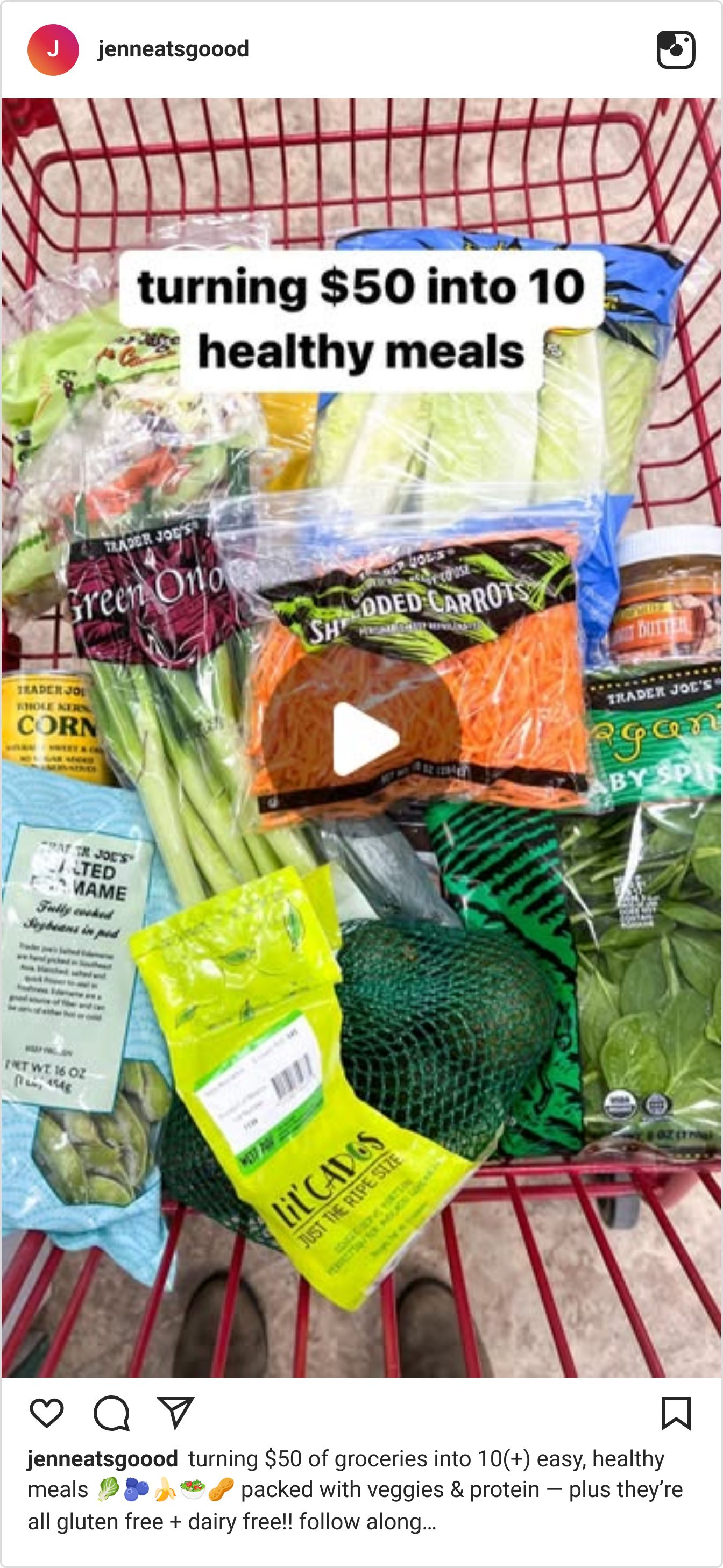
Today, that video has 1.1 million views, and the recipe videos that followed it also netted hundreds of thousands of views, with one even surpassing the original shopping video. The concept worked, and one month later, she ran it back, this time with a $50 budget.
That $50 shopping video has 1.1 million views. The first recipe quickly became her most-viewed video, currently boasting 3.9 million views.
She’d found her breakthrough concept, and followers flocked by the thousands; on March 19, 2023, Jenn posted a cake-baking video to celebrate 100,000 followers. Less than a year after leaving her banking job, she’d increased her following by a factor of 20.
After finally setting out on her own, Jenn added 1 million net-new Instagram followers from September 2023 to February 2024. Ever since then, her following on the platform has continued to grow, but at nowhere near that breakneck pace.
Jenn now has 1.7 million followers on Instagram alone, with a cross-platform total surpassing 3 million.
From Reels to a newsletter and a more stable business
Like most social-first creators, Jenn’s first revenue stream was brand partnerships. For more than a year after her grocery budgeting series took off in early 2023, this was the financial core of her business.
Today, much of her revenue comes through three grouped streams:
Brand partnerships. She favors longer-term, multi-post deals — and runs some through the newsletter. She's also moved into CPG, co-developing a cashew butter with nut butter brand Ground Up.
Paid newsletter subscriptions. The crown jewel. the eat goood newsletter launched in January 2024 and is on track for $670K in gross annualized subscription revenue this year. At $8/month or $60/year, a price she's never raised, her paid subscriber count is somewhere between 6,979 and 11,250.
Affiliate links and website ads. Passive revenue through her standalone website, which has been the hub of her business from the start — a school friend built it as the final project for a web design class.
The newsletter is now "the number one thing" Jenn spends her time on. Not just producing issues, but marketing it and maintaining the email list, which currently includes over 180K total subscribers.
The majority have come from Instagram using automations through a tool called Grow — think posts where she prompts her audience to comment a certain word, which then triggers the automation to send commenters a link to her newsletter.
"Pretty much every post that I've made in the last two and a half years, from when I started the newsletter, prompts people to join the newsletter list."
Jenn started with one free and one paid newsletter per week; the paid newsletter was always a meal plan. Close to a year later, she added a third (free) send. It’s important to her to keep as much as possible free.
The newsletter, like Jenn’s Instagram before it, focuses on helping the audience with practical, budget-friendly grocery shopping and cooking. Every Friday, they send out a dinner plan for the week. Every month, they send a full-month meal prep plan; this is their most popular offering in the newsletter, specifically designed to structure a month of breakfasts and lunches.
Both of Jenn’s full-time employees work on the newsletter.
Booked
The most recent paradigm-shifting event in Jenn’s business occurred at the start of 2026: she published a book titled Don’t Think About Dinner. It’s an extension of the practical, budget-conscious approach to cooking evident in her videos and newsletter and a high-water mark on her journey to date.
Producing the book took around two years; Jenn began work on the proposal in early 2024, a year after her content really started to take off and just as she launched her newsletter. The reason she made her first full-time hire was because of the book; she knew she’d need help managing the always-on parts of the business during production.
@jenneatsgoood I'm a bestselling cookbook author, and I genuinely think most people have no idea what goes into making a cookbook when they see it in a s... See more
Why go through this grueling, disruptive process? It’s not about book sales. “There's a kind of joke, at least within the cookbook world,” Jenn said, that you don’t make any more publishing a cookbook. Photography alone can cost six figures. Rather, it’s “a practice in growing your brand.”
That practice meant hiring a publicist, meant going on Good Morning America and The Today Show, not to mention local news and a book tour.
“As a business owner, but also as a public figure, that really helped me get serious, have more people know me, hopefully. Grow my followers.
It's very hard to know where [followers] are coming from, but I would assume my new followers are coming from places like that as well. Seeing the book out in the store, looking me up, all of that.”
Business is booming. Jenn has well surpassed her salary at the bank and is already planning her next book. She’s built a high-output media business that solves a real, practical problem for a large audience willing to pay for it.
Subscribe to the eat goood newsletter.
Connect with Jenn on Instagram or LinkedIn.
Your audience belongs together.
Why build your newsletter on one platform, your podcast on another, and your website somewhere else? The more disconnected your tools are, the more disconnected your business becomes. beehiiv brings everything together in one place, so your audience can grow together too.
This is an advertisement.

Jenn’s ability to professionalize creator work
It took Jenn five years to catch momentum; what differentiates her and any strong creator is the ability to sustain and build on such momentum. Identifying what works about a hit post, replicating and renewing the components of that hit, and launching additional channels and business lines at the right time.
Of all the factors at play in Jenn’s rapid rise, I’d highlight three, all focused on professionalization:
1. Working in a highly structured professional environment before committing to creator work.
Many of the most impressive creator-entrepreneurs we’ve featured have some sort of white-collar background, such as consulting or, in this case, banking.
I asked Jenn about how this background has influenced her work; she cites a baseline level of professionalism — especially concerning communication and strategy — that she practiced from the beginning, even when she had just 2,000 followers and was pitching brands to send products for her videos:
“I was making no money, [but] I knew how to send an email, and I knew how to be professional. […]
It sounds simple, but I do think if you don't have that experience beforehand — maybe someone who went from either high school or college right to being in this creative field — it actually can be pretty hard to figure out those types of skills.”
This tracks with something another recent guest, Jerome Aceti, told me. He was one of the people Jenn mentioned above who went straight into creator work (he dropped out of college at the start of his sophomore year), but he figured out the skills she’s talking about.
Many of his peers and collaborators, however, lacked email etiquette, lost brand deal renewals due to under-communication, and often failed to think beyond the short term.
It’s always better to over-communicate in remote work, as a creator or otherwise.
2. Working for another creator first
Creator work or not, when she’s been choosing between potential jobs, she’s always chosen the option with the greater opportunity for learning.
Jenn took a pay cut in swapping her banking job for what was functionally an apprenticeship with Liz Moody, but it’s so clearly the right choice in hindsight — at least for someone in her position, chasing a career in the latter arena over the former.
As the creator class professionalizes, we will see more roles like this on the market. Creators making their first hire and looking for multi-talented creator aspirants; creators building out full teams and looking for specialists.
In that year, working for Moody, Jenn both learned skills to take to her own business and was afforded time and kinship while working on her own content.
For folks considering leaving a “normal” job to pursue creator dreams, it’s worth seeking out roles like this as a functional apprenticeship.
3. Embrace outsourcing, but time it right
Among creators I’ve interviewed with multi-six-figure businesses and beyond, vanishingly few are true solo operators. At a certain level of volume and scale (it varies case by case), there’s only so much one person can do.
Jenn built her business on short-form video. Everything stems from this medium. But the end-to-end video production process can only be made so efficient. For a single meal prep video, Jenn could shoot two-and-a-half hours of footage.
Conversations between Jenn and her husband kept returning to a need to spend less time sitting at her desk absorbed in CapCut. So, eventually, she had to outsource video editing. This was “scary”:
“I was like, ‘I can't [outsource], because there's a certain way I edit it, and that's why people like the videos.’ I think all of us kind of feel that way.”
But she made the leap, and now, she says, “the earlier you can do it, the better.” Find somebody you can trust and “commit to having that little period of uncomfortability with it.”
This goes for creators in any medium (at a point of scale where you need to free up time and have steady revenue streams). Jenn developed a style and the ability to give feedback on that style; the editor just had to learn it.
