


Center Consoles Only (CCO), which started as a custom boat photography aggregator on Instagram ten years ago, is now a multi-armed business branching even into SaaS for boat dealers.
Slow Ventures’ Creator Fund recently invested $2.5 million in the business.
To get the story, I spoke to CCO co-founders Alan Blanco, Brian Gonzalez, and Eric Taggart, as well as Slow Ventures partner Megan Lightcap.
In this episode:
— Francis Zierer, Lead Editor
Reaching your audience shouldn’t take 12 tools.

Your newsletter is here. Your website is there. Your podcast analytics are a mess. Your community is just a Facebook chat. And somehow, you’re the one stuck connecting it all.
beehiiv brings your content, audience, and business together on one platform. Create newsletters, publish podcasts, build your website, grow your community, and earn from subscriptions, ads, and digital products without duct-taping a dozen tools together.
If you're ready to stop jumping from platform to platform, here's your sign to connect your entire business on beehiiv. You'll spend less time managing your tech stack and more time building something people truly love.
This is an advertisement.


A $7k Instagram acquisition to a $2.5m fundraise
Is $7,000 a good price for an Instagram page?
Consider that the page has around 30,000 followers. Consider that it is 2016. Consider that you are Alan Blanco, and you are obsessed with center console boats.
Consider that, earlier this year, a decade after purchasing the Instagram page, Alan and his partners raised $2.5 million in venture capital for a larger business grown from the seed of that page. They didn’t need the capital injection, certainly not with any urgency — the business was already profitable.
Alan describes Center Consoles Only (CCO), the media arm of his business, as an “opportunity creation machine.” More than anything, they raised because they needed seasoned partners to tackle their biggest opportunity yet.
(If you, like me, have not spent much time around boats: a center console is a type of boat where all of the controls sit at the center of the vessel, leaving ample space for passengers to maneuver around the edges for fishing.)
Today, the @centerconsolesonly Instagram page is just one piece of a business that spans media, software, and, yes, physical boats.
Center Consoles Only (media)
Core services now include: classic social media promotion, bespoke content creation, social media management, event coverage, and custom solutions (including full-scale web development).
1.72 million total followers:
Instagram: 543k
YouTube: 90.9k
Facebook: 460k
TikTok: 631.4k
Orion Boatworks (boat manufacturer)
Since 2022 — partnership with a man named Adriano who’d approached the CCO crew with molds for a classic boat hull. The CCO team designed the boat based on everything they’d learned over their years filming boats. Now run as a subcontracted operation.
20 deposits collected before the first hull was completed (purely from their social media presence). Nearly 40 boats out on the water to date.
Open Fisherman (e-commerce)
Acquired the domain (“open fisherman” and “center console” are two terms for the same type of boat). Running for half a decade. Drop-ship model (apparel, safety gear, boat accessories).
Raised $600k for non-profits through raffles.
Still live, but not a primary focus.
Boats Only (social network, classifieds, creator hub, SaaS)
Launched at the end of 2025, this is the major bet for the future of the business, and the bet that drove Slow to invest.
Social network: Think a Facebook group, built especially for boat enthusiasts, or a return to the early-2000s, interest-based forum format. There’s a feed, DMs, jobs, the works.
Free classifieds: Competitor to Facebook Marketplace specifically for boats (undercuts other sites that charge dealers thousands of dollars per month to post).
Creator hub: A B2B creator marketplace matching boat brands to vetted creators (think: specialized Fiverr). For example, a manufacturer could submit a video for remixing by multiple creators. Boats Only holds payment in escrow, to be released once deliverables are approved (and takes a transaction fee).
SaaS tooling for boat dealers: The newest and largest bet. Boat dealers might spend $10-30k per month on tools from CRM to accounting, none of which are purpose-built for the specific industry use case.
Boil it all back down, and every part of the business comes back to a few people passionate about recreational boating leveraging their passion and skills to connect people selling boats with people buying boats.
I asked Megan Lightcap, who led the investment on the Slow side, about identifying good fits for their Creator Fund:
“We want to find people who are so deeply passionate about this space and through that passion have built deep, deep community around that thing and have unbelievable trust with their audience. Like, they speak the same language. We joke around — these are sort of cult leaders, right?”
There’s no such thing as a creator, really. At this point in the evolution of the creator economy, as the field becomes increasingly professionalized, the word loses meaning. “Creators,” in the sense of social media users building and seeking to monetize an audience in earnest, are no different than startup founders.

The acquisition that enabled the business
Now in his mid-forties, Alan has been building and engaging in online, boat-focused communities since the early 2000s. He grew up fishing on center console boats with his father. It’s a lifelong passion: “I could name any boat, any year, and approximate price range when I was like twelve years old.”
By 2012, Alan was running an Instagram page called Poop Deck. This was well before video content took over Instagram, and Alan’s page was filled with aggregated (but credited, of course) boat photos. By 2016, he says, he’d grown it to around 150k followers, but he knew the page, name, and concept only had so much mileage.
Then, a younger man named Ian Scott approached Alan asking for advice on growing his Instagram page, @centerconsolesonly — here was a concept he could run with.
Alan made Ian an offer for the page, which had around 30k followers at the time, and the two negotiated a final price of $7,000. And he immediately made back half the cost in a deal with Streamline Boats, a company he’d already been working with through Poop Deck.
Streamline was a young company (Alan remembers them having sold only one boat by then), but they paid him $3,500 in exchange for his help growing their business through the page. Alan’s work soon helped them sell “sixteen or eighteen” boats, and he collected a referral fee each time.
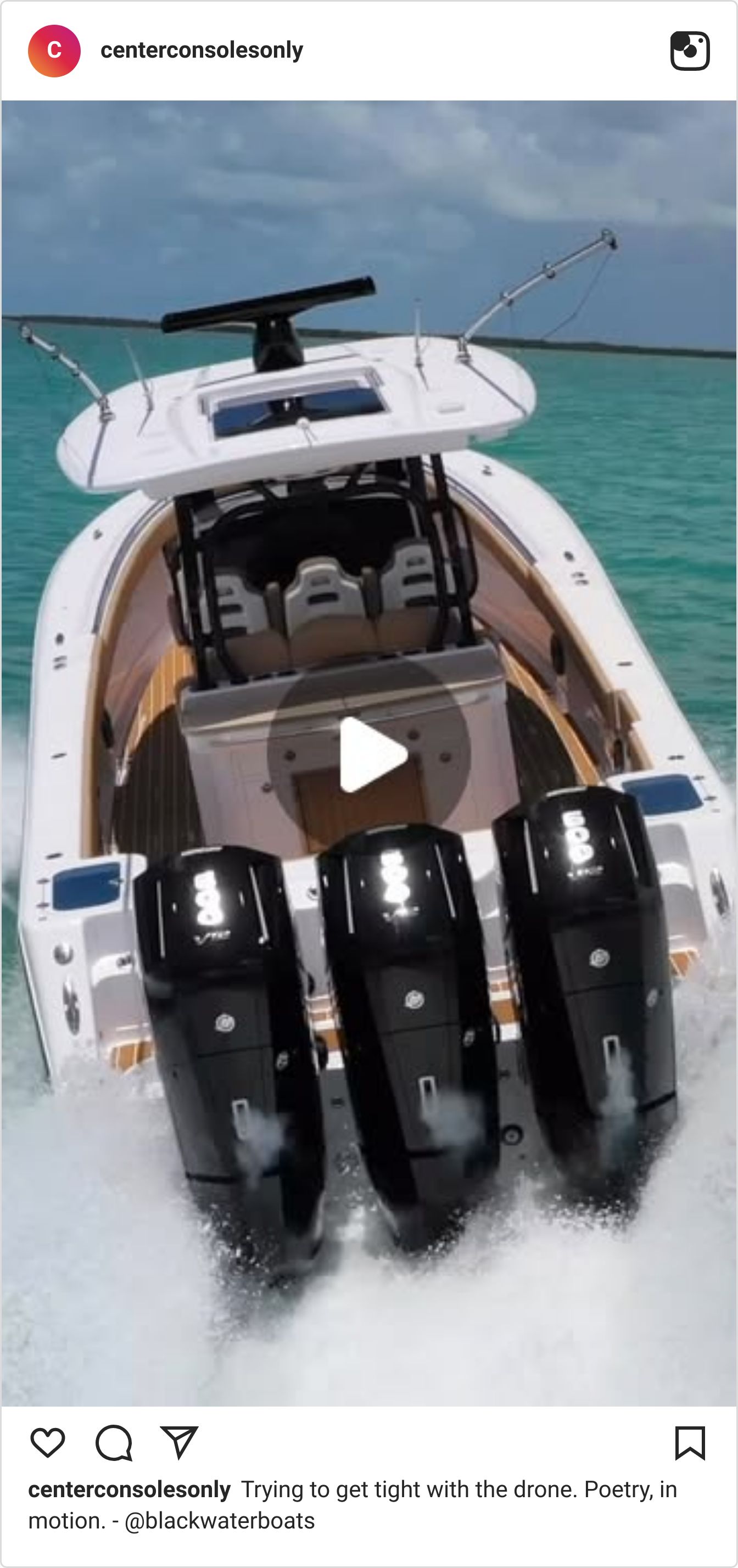
How the Center Consoles Only business was born
Shortly after acquiring the CCO Instagram page, in 2017, Alan launched a marketing content subscription business for boat manufacturers and dealers. There were three tiers, priced on a per-post basis:
1 post per month: $250 per month
2 posts per month: $500 per month
1 post per week: $1,000 per month
Businesses subscribing at these rates would provide their own content; otherwise, Alan began offering higher-ticket packages including quarterly shoots. Over time, CCO would increasingly lean into that original content.
Acquiring customers was a cold-call grind at first.
“I don't know how many phone calls, how many emails I sent out to owners of boat manufacturers, dealers, and stuff like that presenting this to them.
Obviously it took quite some time for them to actually give us a shot. Once they did, I think I had probably ten or twelve manufacturers that agreed to it.”
All this time, CCO was a side project; Alan was working for his father’s construction company. Once he’d assembled that initial dozen-or-so customer base, he spoke to Brian Gonzalez, a developer, friend, and collaborator on previous products, and asked for help building a website.
It was around this time, in the summer of 2018, when part-time work on CCO began generating almost as much money as Alan’s full-time construction job. After wrapping up a major construction project, Alan went to his father and expressed his desire to take a month off, give CCO his full attention for 60–80 hours per week, and see what he could do. This was a high-stakes bet, with Alan and his wife welcoming their first daughter that same month.
“It was the best and worst time to do it. Very stressful, but you know, in my mind, failure was not an option. I had to make this happen.”
By the end of that month, the CCO subscription customer base was somewhere in the “30 to 40 manufacturer range.” More than enough clients to fill their content calendar at that point, and they began offering more custom content packages.
Alan’s month off from construction turned plural.
Much more than a content business
Within a few months of committing to CCO full-time, Alan welcomed Brian to the team full-time as a co-founder. They were soon joined by Eric Taggart — a film-school-trained videographer who’d previously worked with the Miami Heat (and happened to be Alan’s brother-in-law).
The content kept getting better. What started as a feed of aggregated stills, many eventually provided by manufacturers on that subscription model, became a video feed. First-person videos shot by Alan turned into documentary-style shoots with Alan as an on-camera character.
They expanded from Instagram to TikTok and YouTube and, all the while, Alan learned more and more about the intricate details of how to build a boat. They stopped needing to reach out to potential shoot subjects, their inboxes filling with pitches.
And, with a strong media-and-marketing business at the center, the crew began casting out all additional business lines. Some caught, some didn’t.
In addition to the ongoing business lines described earlier, the group has launched and moved on from others, including a waterfront real estate business ($50–60M in sales in the first year, exists in a different form through a previous business partner), a boat brokerage (shut down in part due to conflict of interest), and a boat club (membership model, shuttered due to insurance cost).
The boat club only lasted for about a year, but it caused them to shop around for equity partners for the first time, ultimately leading to their relationship with Slow Ventures.
Key to both sides agreeing to funding was Boats Only, the combination social network, classified platform, creator hub, and SaaS.
Though less than a year old, Boats Only has massive potential. The incumbent, Boats Group (which owns major classified sites and charges dealers thousands a month to list), recently changed hands in a reported $2 billion private-equity deal. It's also facing broker anger over pricing: an antitrust suit filed last year claims subscription fees have climbed more than 400% in a decade, and while a first version of the suit was tossed out in June, brokers remain frustrated. This tension opens the field for a grassroots operator like CCO, with a brand built on hard-earned trust, to come in and disrupt.

That trust manifests in CCO’s WhatsApp group full of top boat manufacturers and dealers. This is the community they’ve produced over the last decade; this is the focus group for their big bet. And this is why Slow invested $2.5 million, one of just a few publicly-announced investments from their Creator Fund (Megan mentioned more completed investments yet to be publicized).
For now, Boats Only is still a bet, not yet a year old. I asked Alan what he hopes to have achieved in three years that he has not yet achieved today:
“Right now what we're embarking on with boatsonly.com is, like, a thousand times more than what I ever dreamt was possible. Before, we [thought] — we'll create content, we'll build boats, and people might remember us from the content we created and hopefully providing value there.
But now [Boats Only] really could be the savior for the marine industry, something they've never experienced before and no one has really taken the time to do, or had the capability to build — or had the knowledge just from being in the trenches with everyone to be able to put together properly.”
Is Alan a creator? Sure, though at this point, we might just use the word “founder.” What’s the difference?
Subscribe to Center Consoles Only on YouTube or Instagram.
Learn more about Boats Only.

Building trust with your audience
Had Center Consoles Only remained a still-image aggregation page, it wouldn’t have built the business it has today. It’s not that a scaled, more polished version of that original idea wouldn’t play; rather, the value CCO continues to build today is rooted in Alan, his character, and Alan-as-character.
None of this works without that personality at the center, and the content needs to foreground that personality. As the business evolved, here’s how Alan strategically leveraged this to build trust with his audience.
Stage one: Obsession
“At the beginning, obviously sharing other people's content, there really wasn't any trust,” Alan told me. All there was was his curation; he had an eye for boats and would Google around for great photos.
His obsession kicked everything off, but his face wasn’t there, and he was shooting by himself, so it was more difficult to get his face in the shot.
Stage two: From still to video
As he gained customers and began offering custom content packages, Alan started going out to film boat videos himself.
“I would go with a GoPro and just kind of vlog it all the way through for YouTube. And then the social media content became like a first-person view of what I saw. So I would walk people through the boat, and really all you would see is my hand opening a hatch, pointing at something, and then my voice kind of narrating what it is that I'm seeing.”
Now, his audience was learning with him, but still didn’t see him. He was still less a character, more a messenger. This went on for a few years, until …
Stage three: On-camera
Finally, Alan’s brother-in-law and co-founder Eric joins him to shoot the videos. Alan is now walking his viewers through a boat in front of the camera, with better footage shot by a trained professional. At the same time, they’re using wide-angle lenses (before the 0.5 lens became widely available on iPhones; the perspective was novel), creating a unique look in their niche.
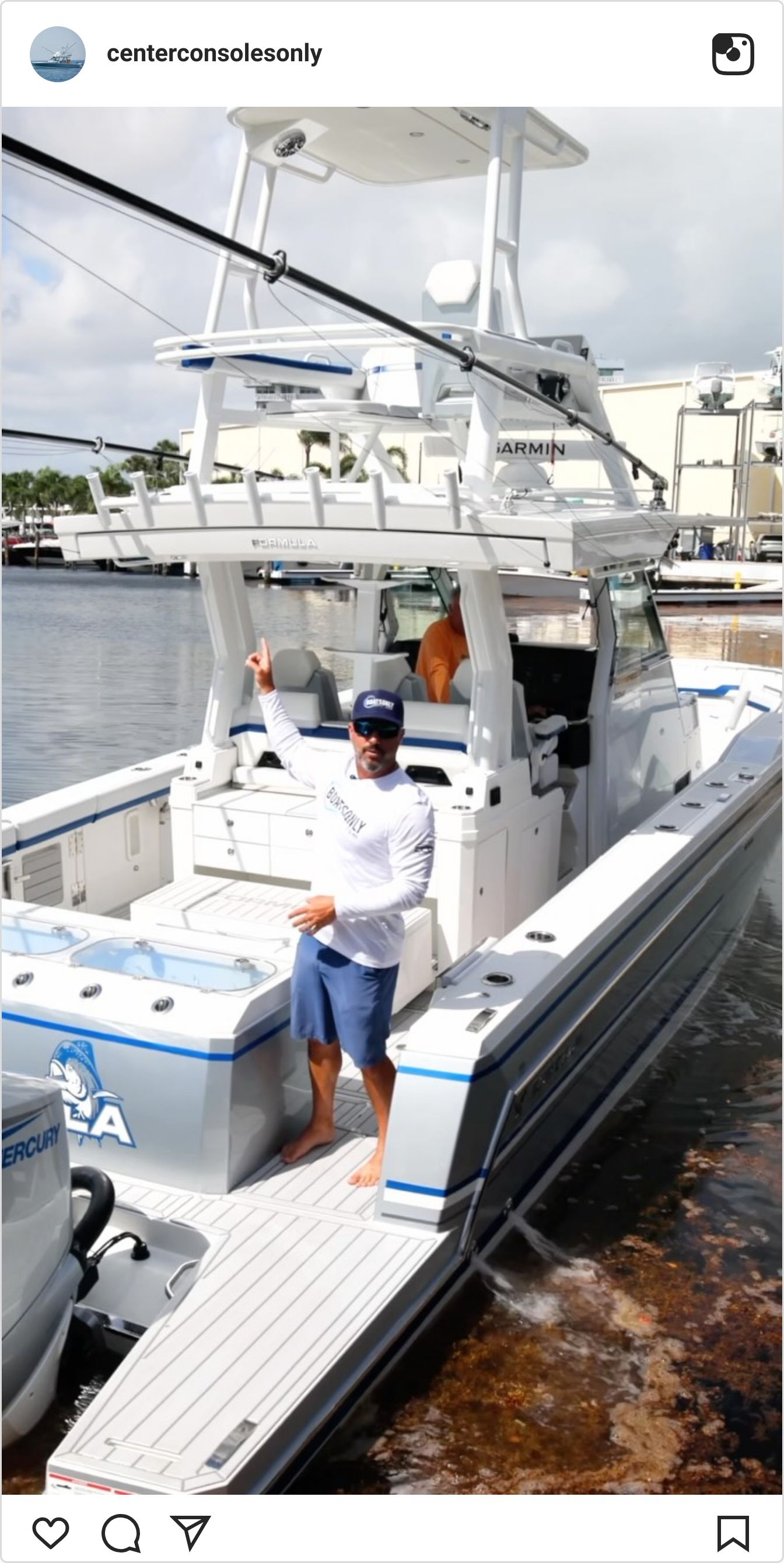
Alan moving from behind to on-camera is pivotal. As he put it, “That's when the trust started becoming a little more evident.”
Alan becomes more confident in his knowledge — he now feels comfortable sharing his opinion. He’s a face for people to relate to. This is around 2020. And this is what enables CCO to go from a few social media pages to an ever-expanding business.
People start DMing the page to ask him questions. He still answers these messages himself, though the volume is often such that he can’t keep up. Oftentimes, he’ll even share his phone number — “I'll spend thirty minutes on the phone with these people explaining my experience, you know, comparing different boats that they have in mind.”
The CCO, Alan-as-character approach differs from the first iteration of CCO and, as Alan puts it, “all these cinematic videos and dramatic, you know, drone footage with music.” It produces trust, durability, and the foundation for a more ambitious business.
