


Today’s guest is a physical therapist by trade who, like many knowledge creators, became a creator almost by accident.
The audience she built through her short-form fitness videos enabled her to launch a software business backed by $1.1 million from Slow Ventures’ Creator Fund.
In this episode:
— Natalia Pérez-González, Assistant Editor
Catch the idea before it’s gone

Your best line of the week probably showed up at the wrong time. Halfway through a run, in the checkout line, two minutes before you fell asleep. By the time you're back at a keyboard, half of it's gone.
You don’t have to get the sentence right before you say it. Ramble a little, change your mind halfway through, throw in an um. Wispr Flow sorts that out as you talk, turning your words into a clean draft right where you’re writing. Notes, beehiiv, Google Docs, a DM. Any app on your phone or computer, four times faster than typing.
Picture opening your laptop to three hooks, an outline and a sponsor reply already written.
Wispr Flow is free. Get one month of Wispr Flow Pro with unlimited words through our link.
Sponsored and dictated by Wispr Flow!


Is your audience your main customer base?
Tayla Cannon’s career as a creator is defined by short videos challenging conventional fitness advice, often demonstrating exercises that help people train around pain.
Like many experts and knowledge creators we’ve spoken to, Tayla didn’t originally set out to be a creator. She was licensed as a physiotherapist in Australia, but after moving to the States, she never pursued American licensure, since her work doesn’t require her to diagnose or treat patients. Her own chronic back pain had convinced her that people who train don’t need a diagnosis or time on a treatment table, just someone to guide their workouts.
Instead, she started an online rehab-coaching practice.
Her approach has found a receptive audience; 230,000 Instagram followers (already up 7,000 from when we recorded our podcast). One of her recent Reels about muscle groups has amassed more than 680k views, while others tackle everything from lower-back warmups to the misunderstandings around tight hip flexors.

Instagram was, at first, simply a way for her to find more clients. She began sharing workouts midway through 2023. Over time, she settled into a rhythm of roughly 14 Reels per month.
By the end of 2023, she had a modest 9,000 followers.
By the end of 2024, she’d reached 52,000 followers.
By the end of 2025, she hit 142,000 followers.
Her audience expanded from customers looking for relief to peer clinicians who shared her philosophy — some of whom wanted to know how they could build an online practice of their own.
That audience now supports several revenue streams, beginning with brand deals.
Her earliest brand deal was casual: someone emailed offering $500 to put a specific song behind one of her Reels.
Her first negotiated partnership came at around 100k followers, once she had a manager. It was with a barefoot shoe company, and offering a six-month contract at $3,000 a month for one Reel and two or three Stories each month. They renewed for 12 months at $4,000 a month, with the same deliverables.
Now, a supplement brand pays her on a similar 12-month structure, at what she says is a comparable rate. Another software company for creators sponsored her to speak at VidCon.
Sponsorships are useful supplementary income, but she's not particularly interested in building a larger business around them.

Launching a software business off an engaged audience
Beyond sponsorships, Tayla makes her living selling training programs to consumers, certifications to clinicians and coaches, and software. Consumers buy her training programs, while clinicians and coaches enroll in a certification that teaches both her approach to integrating rehab into training and the business of delivering it online. Her students are spread across the US, Australia, and Europe, roughly mirroring the geography of her Instagram audience.
Behind the business is a team of around seven people, including an assistant, an operator, a newly hired editor, and four engineers.
As her audience grew, Tayla was also building something far more ambitious than a content business. Running her virtual rehab practice had exposed a glaring gap in the software available to clinicians working online.
She needed a platform that could:
Support her approach to coaching
Accommodate the industry's compliance requirements
And replace the patchwork of tools she'd been using to manage clients.
So she set out to build Rebuildr, a software company designed to help clinicians and coaches deliver rehab-integrated training online.

She pitched the idea to her audience through two Instagram Stories about a year and a half ago, testing whether anyone else wanted what she was building. Nearly 1,000 people expressed interest, and according to Slow Ventures, 350 physical therapists applied to beta test a product that didn't yet exist.
Slow invested $1.1 million for a 12.5% stake, she told us, which implies a valuation of about $8.8 million. Tayla hadn't been seeking investment, and she hadn't prepared any of the usual fundraising materials.
“I don't have a pitch deck,” she told us. “I still don't have a pitch deck.”
What she did have was an engaged audience, enough for her to gather data on whether or not people wanted what she was building.
Targeting two audiences with one account
Prior to launching her software, Tayla’s content catered to a consumer audience. But an audience willing to help validate a product isn't necessarily an audience willing to buy it.
Most of Tayla's followers are consumers looking for workout advice, while Rebuildr sells software to clinicians and coaches. When she tried showing followers wireframes and prototypes, the response made that distinction painfully clear.
“People don't want to get on my screen and see wireframes and prototypes,” she told us. “That's not why they follow me.”
It would be a disservice to her audience if her Instagram was a running advertisement for Rebuildr; she’s had to create and maintain a funnel that accounts for her audience fragmentation — moving the right people toward the right products.
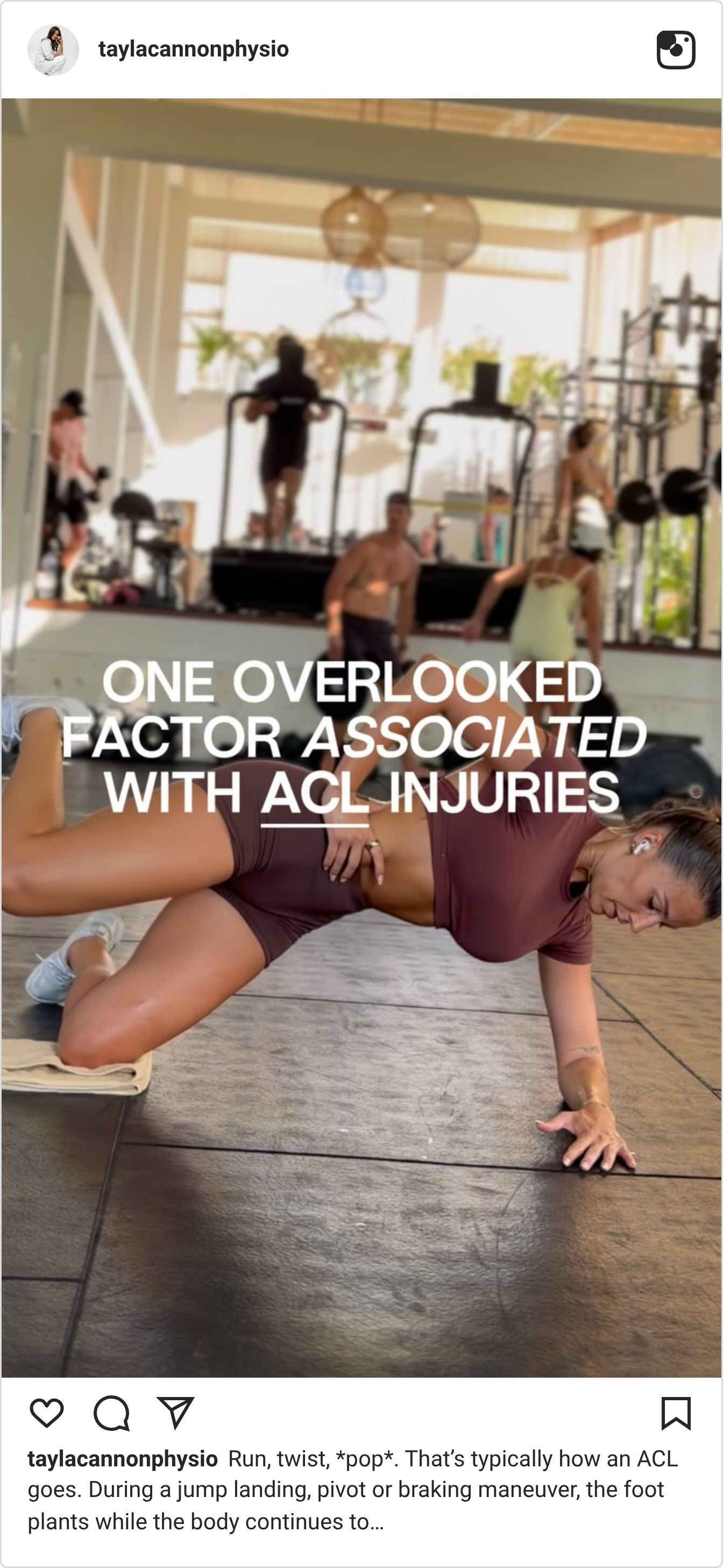
Her content mix has to be both consumer- and business-facing:
Consumers looking to train around pain. This is the bulk of her audience, drawn to accessible exercise advice, myth-busting Reels, and demonstrations they can put into practice themselves.
How she serves them: Broad topics tend to earn the most views, but don't necessarily translate into sales. For followers who want more guidance, Tayla offers training programs and access to Rebuildr's marketplace of clinicians.
Clinicians and coaches looking to build their own businesses. This smaller, more commercially valuable audience is drawn to Tayla's philosophy of integrating rehabilitation into training. Specialized videos might reach fewer people, but attract professionals who want to adopt her approach.
How she serves them: Tayla funnels them into a certification program that teaches both her methodology and the business framework for delivering it online. Rebuildr is the software they learn to use along the way, making the certification both a revenue stream and a customer acquisition channel for her software company.
The two funnels can begin with the same Reel. A consumer watches Tayla demonstrate a lower-back warmup and saves it for their next workout; a physical therapist sees the same exercise and recognizes an approach they'd like to bring into their practice. Comment-to-DM automations help move interested viewers toward more specific resources, without forcing Tayla to turn every video into a sales pitch.
It's a more sophisticated use of Instagram than simply chasing reach. Tayla knows which broad topics could grow her following faster, but she's increasingly thinking about the value of the people those posts attract.
Her funnel has done more of the marketing than she expected. A year after Slow’s investment, she’s barely touched the money beyond carrying development through launch, because her organic content is directing customers to her product. Now, she’s looking at paid marketing to reach beyond her own followers.
That payoff is also why she wants to rearrange her week. Operations take 95% of her time, and content gets 5%. Within a year, she wants content at 90%.
“Everything that I do exists because of content,” she said, “so content should stay number one priority.”

A few notes on what makes a good, accurate hook ✍️
In Tayla’s corner of the internet, the easiest way to go viral is to promise a cure. “Do this exercise and your back pain will be gone” could pull millions of views, she says, even when the claim is false.
Tayla knows she could grow faster by making those promises, but instead, she's learned to borrow the mechanics of viral fitness content without sacrificing the accuracy of her advice.
Going about this intentionally helps protect the credibility of her entire business.
Challenge conventional wisdom
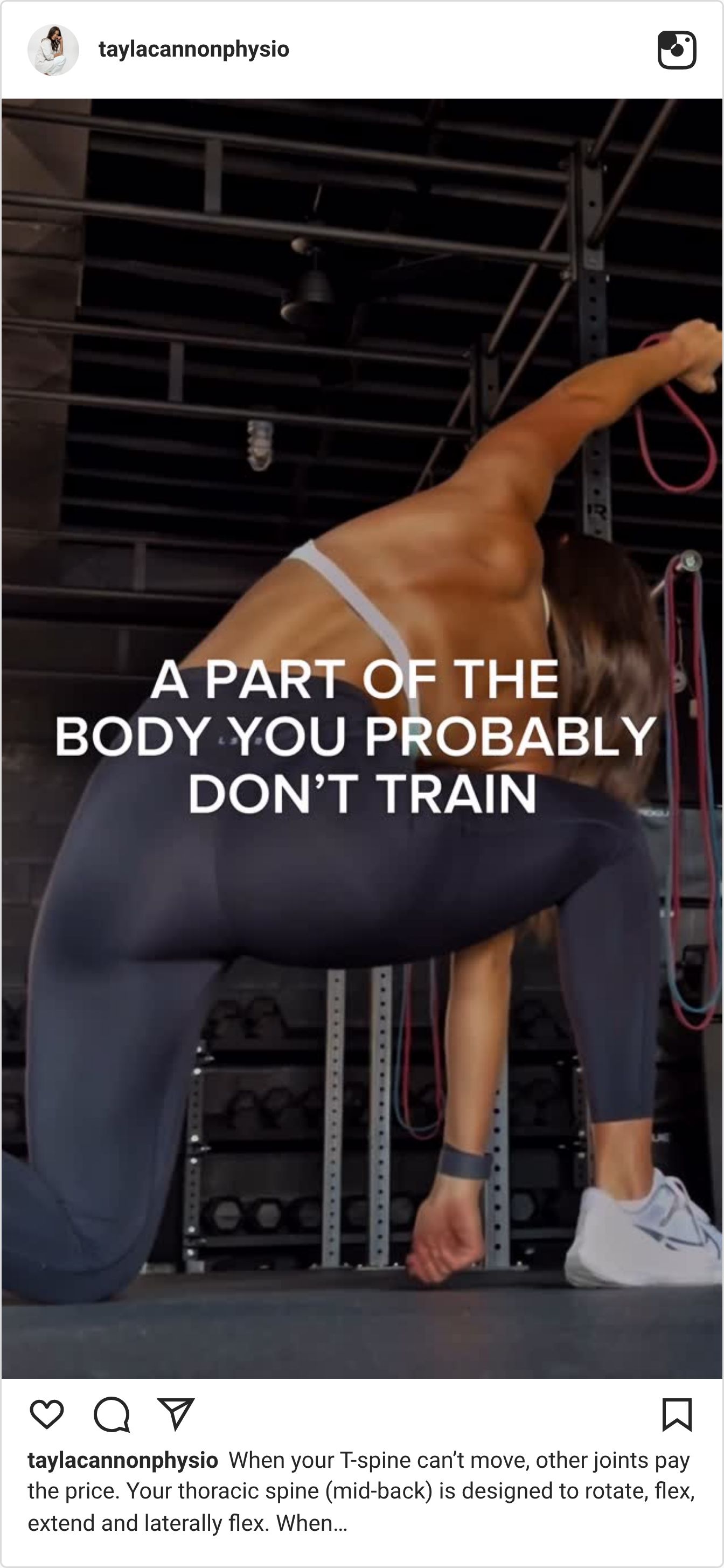
Tayla's first breakout Reel questioned the advice to keep your spine neutral, pointing out that the spine is designed to rotate. The hook worked because it challenged a familiar assumption.
Try this: Find the conventional wisdom in your niche that you can credibly push against, and make your case. Better yet, build those arguments around a consistent philosophy so viewers come to recognize what you stand for.
Make a smaller promise to a more specific audience
Tayla uses the same listicles and curiosity-driven hooks that perform well across fitness content, but she's careful about what they promise.
Rather than offering five exercises that will eliminate back pain, she'll suggest “five things that might help your back pain if you are experiencing X, Y, and Z.”
The format still creates curiosity, but the qualifiers narrow who the advice applies to — what viewers can reasonably expect from it.
Give your expertise room to outgrow the Reel
Short-form video has been an effective way for Tayla to challenge conventional fitness advice, but there's only so much nuance she can fit into a demonstration and a caption. She'll expand to long-form YouTube in 2027, where she can spend 20 minutes unpacking questions in-depth.
Her goal is to reach 100,000 subscribers within a year.
There's a useful division of labor here for knowledge creators. A Reel can make someone reconsider what they thought they knew; a longer video gives the creator room to tease out their ideas and philosophies, to apply more context.
For creators like Tayla, whose credibility rests partly on resisting the easy answers common in fitness content, this extra step is vital.
