

Brought to you by beehiiv.
Maxie McCoy has been writing online for 17 years.
She's a Wall Street Journal bestselling ghostwriter, the author of two of her own books, and the person behind a 14-year-old newsletter with 40,000 subscribers.
In this episode:
💼 The many arms of a knowledge-creator business
💰 The pricing ladder from $0 to $150K per book
🎭 The retreat and return of a girl-boss-era creator
— Natalia Pérez-González, Assistant Editor


Anonymous bestseller
Maxie McCoy's most successful work doesn't have her name on it.
It’s easy to miss, because by every other measure, her writing career is prolific. For 14 years, she’s written a weekly newsletter, In My Library, which now has around 40,000 subscribers. In 2018, she published a career guide called You're Not Lost. Six years later, in 2024, she self-published a historical novel called Daisy.
She's hosted podcasts, run brand campaigns for Microsoft and T-Mobile, and sold LinkedIn courses to 150,000 learners.
Today, 90% of her revenue comes from books and speeches she writes for other people, most of whose names she can't say out loud.
Her first foray into ghostwriting came in 2010, when two Dallas entrepreneurs needed someone to write their self-published book, Less Work, More Money. McCoy, fresh out of Lehigh's journalism program, took on the job for free — in retrospect, it was a training ground for her paid ghostwriting work a decade later.
Her first paid project, a $75,000 book deal, nearly broke her. McCoy was meticulous; she painstakingly hand-transcribed every client call while racing against a three-month manuscript deadline. It paid off, though — her work landed the book on the Wall Street Journal bestseller list, and she immediately began drawing in agents, compounding demand, and steadily increasing her leverage.
She’s since scaled to a pricing model in which she can charge $20,000 for a proposal and $150,000 for a full manuscript.
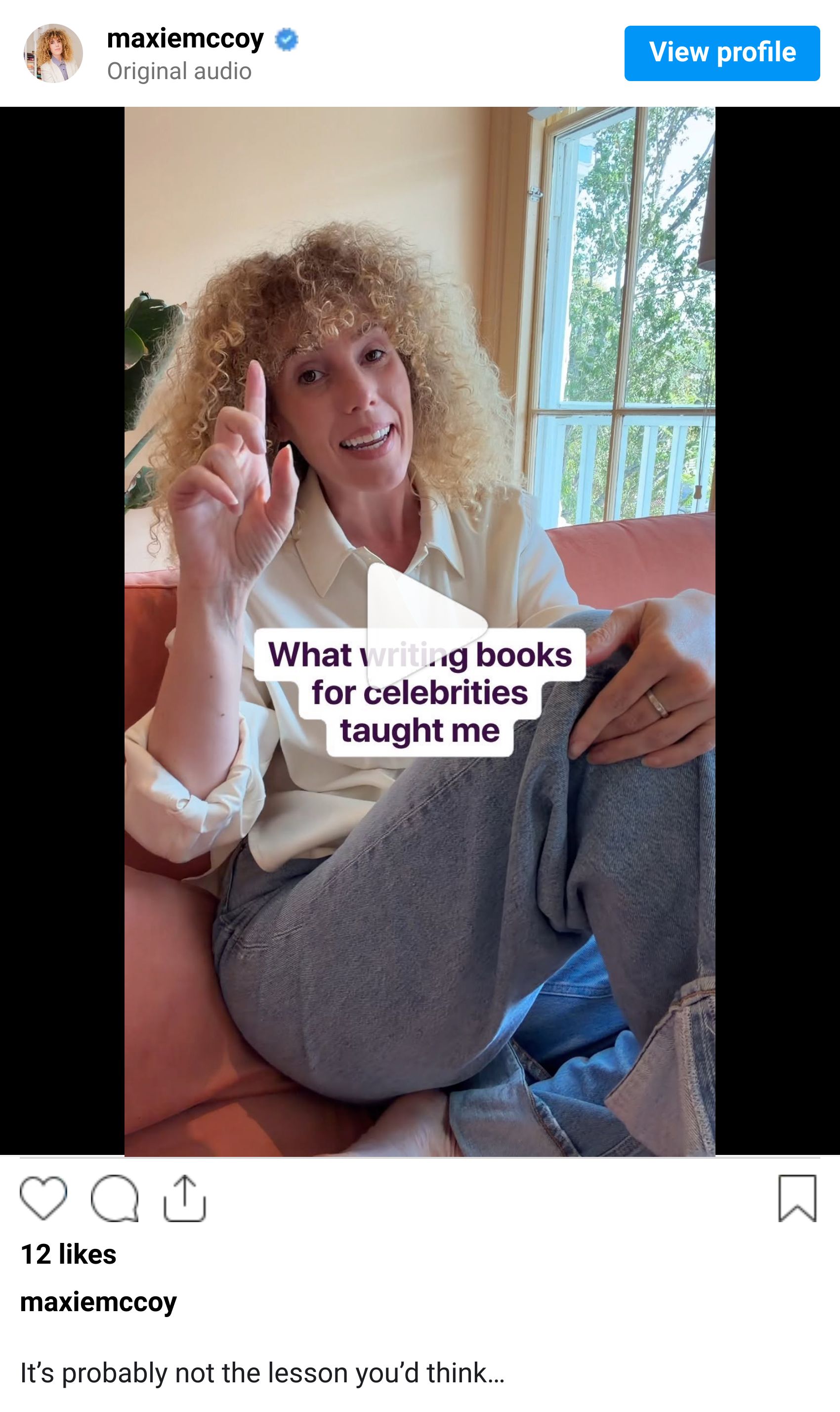
McCoy’s popularity rose during the height of the 2010’s girlboss era — multiple speaking engagements, brand partnerships, a book published at the peak of the moment. But after the pandemic reshaped our economic and cultural landscape, the model she had watched her peers build into full-fledged media companies felt outdated, and no longer the path she wanted to follow.
She reemerges now, with a different kind of clarity. Six months ago, she hired a social media agency to help her get back into a daily posting cadence, setting a modest goal of booking one speaking engagement within that window — and ultimately securing two.
She borrows a line from Adele to describe her framework: you can’t write an album about a life you haven’t lived. The past five years, in that sense, were the life. The next five, she hopes, will be the album.

Connect with Maxie on Instagram and LinkedIn.
Subscribe to In My Library.

Two techniques for your ghostwriting practice
From Natalia Pérez-González — a couple of ideas that stuck with me as I listened through this week’s conversation. McCoy’s work as a ghostwriter is focused on books and speeches. We’ve previously featured Nicolas Cole, whose businesses teach people other forms of online ghostwriting — catch up on that feature here.
Price against the market, and use Publishers Marketplace to do it.
Publishing is deliberately opaque about ghostwriter fees, which is why most first-time ghostwriters either undercharge by half or overshoot and lose the deal. Ghostwriting deals are long (typically 18–24 months) and it’s important you lock in a fee that’s worth your investment.
McCoy's shortcut: a $25/month subscription to publishersmarketplace.com, which lists every book deal happening in traditional publishing — the agent, the editor, the imprint, and a pricing tier (they don't show exact numbers, but specific keywords map to specific ranges). One month of access gives you a full map of who's buying what, at what level, in your category.
Also, ask your peers directly what they’re charging, and calibrate accordingly.
Split the engagement into two contracts, and get paid before the manuscript ships
McCoy sells the book proposal — the 40-page business plan that sells the book to publishers — as a separate, linked contract from the manuscript itself. Proposal: $20K. Manuscript, if a deal lands: $150K. She gets paid for the proposal work regardless of whether the book sells, which protects her from clients who get cold feet after a publisher bites.
In the manuscript contract, she aggressively negotiates payment terms. Publishing has quietly restructured ghostwriter payouts over the last few years — what used to be 50% at signing and 50% at delivery is now fractured into quarterly chunks, with some money landing six months after the book publishes. That can stretch a fee out over three years. McCoy's hard line: every dollar hits between signing and manuscript delivery.
