

Brought to you by beehiiv.

Today’s guest is the latest practitioner in the beloved tradition of space media, a Bill Nye born on YouTube. In just a few short years, he’s built an audience of millions by making the universe easier to understand.
In this episode:
— Natalia Pérez-González, Assistant Editor
The ops hire every solo creator actually needs

You're the writer, editor, strategist, and analyst. Most creators at your stage are still doing all of it themselves, pulling sponsor metrics, building decks, chasing data across five tabs.
Viktor connects to your tools and ships the actual work. Ask him to pull last quarter's sponsor performance. Build a media kit from your beehiiv stats. Draft your next outreach sequence. Done. Not summarized. Done.
No new software. No onboarding. He lives in Slack, where you already work.
Most teams hand over half their ops within a week. Start free with $100 in credits. No credit card required.
Try Viktor free.
This is an advertisement.


Shoot for the moon
There’s a well-worn path to virality in space media. You can hint that something might be an alien, leave the answer just out of reach … and watch the algorithm take over. Kobi Brown knows the formula as well as anyone. It’s not his style.
Last year, an interstellar comet slipped through our solar system, and a good chunk of the space internet speculated it might be evidence of alien life.
Kobi dispelled the notion through a long-form breakdown and a handful of shorts, complete with 3D models explaining what the object actually was, and then dropped the topic after. The strategy for follow-up videos was obvious — more speculation would have brought him more views and likely thousands of dollars.
But his bet is on accuracy and legitimacy over the easy spikes, and that choice runs through every part of his business.
@astrokobi 3I/Atlas just got even stranger, it rapidly brightened! #space #3iatlas #science #nasa #astrokobi
Better known to his 8.5 million cross-platform followers as AstroKobi, he started posting short-form space videos from his bedroom in early 2022, as a study aid for his physics degree; stripping a concept down to a short explainer made it easier for him to absorb.
Within his first 20 uploads, astronomers released a new image of a black hole, and his rough short about it pulled nearly 50 million views across TikTok, Instagram, and YouTube.
@astrokobi I heard we’re doing science edits… #spacetok #space #science #blackhole #astrokobi
He continued posting short-form videos almost daily — a streak that lasted roughly 500 days — and, within his first six months, expanded into long-form YouTube videos, eventually signing with a talent agency. Even then, he kept other jobs until he was approaching a million subscribers. Over four years, he has grown his following to 8.5 million across platforms, and when the decision came down to a PhD or content creation, he chose the path with the larger classroom.
The week after we spoke, he was filming with NASA and the European Space Agency in the Netherlands.
Today, roughly 40% of AstroKobi's revenue comes from YouTube AdSense and 60% from brand partnerships, yet his two largest audiences generate almost no direct income.
As an Australian creator, he had no access to TikTok or Instagram monetization, meaning his 3.1 million TikTok followers and 1.3 million Instagram followers functioned primarily as audience acquisition channels rather than revenue streams. (His recent move to London is changing that.)
Behind the polish is a small operation. Kobi still does the core work — research, writing, presenting, most of the editing — but today, roughly eight to ten people touch the AstroKobi business in any given month:
His management (which handles deals, business structure, and outreach to the likes of SpaceX)
A freelance editor
A thumbnail designer who's made nearly every thumbnail since 2022
Three 3D animators and one 2D animator
Animation work eats up the hours. To keep the science honest, Kobi sometimes writes rough Python simulations of a system's true scale before handing them off to be made beautiful.
He's rethought the format, too. Short videos are now his testing ground — cheap experiments to see which ideas land — while long-form is where the real storytelling, and the real growth, happen. His view counts on shorts have cooled since the early frenzy, but his recent long-form videos rank among his most-watched.
None of this, he's careful to say, is conferred by a NASA badge. "Going to NASA doesn't necessarily grant you accuracy and legitimacy," he tells us. "You still need to be communicating truth."
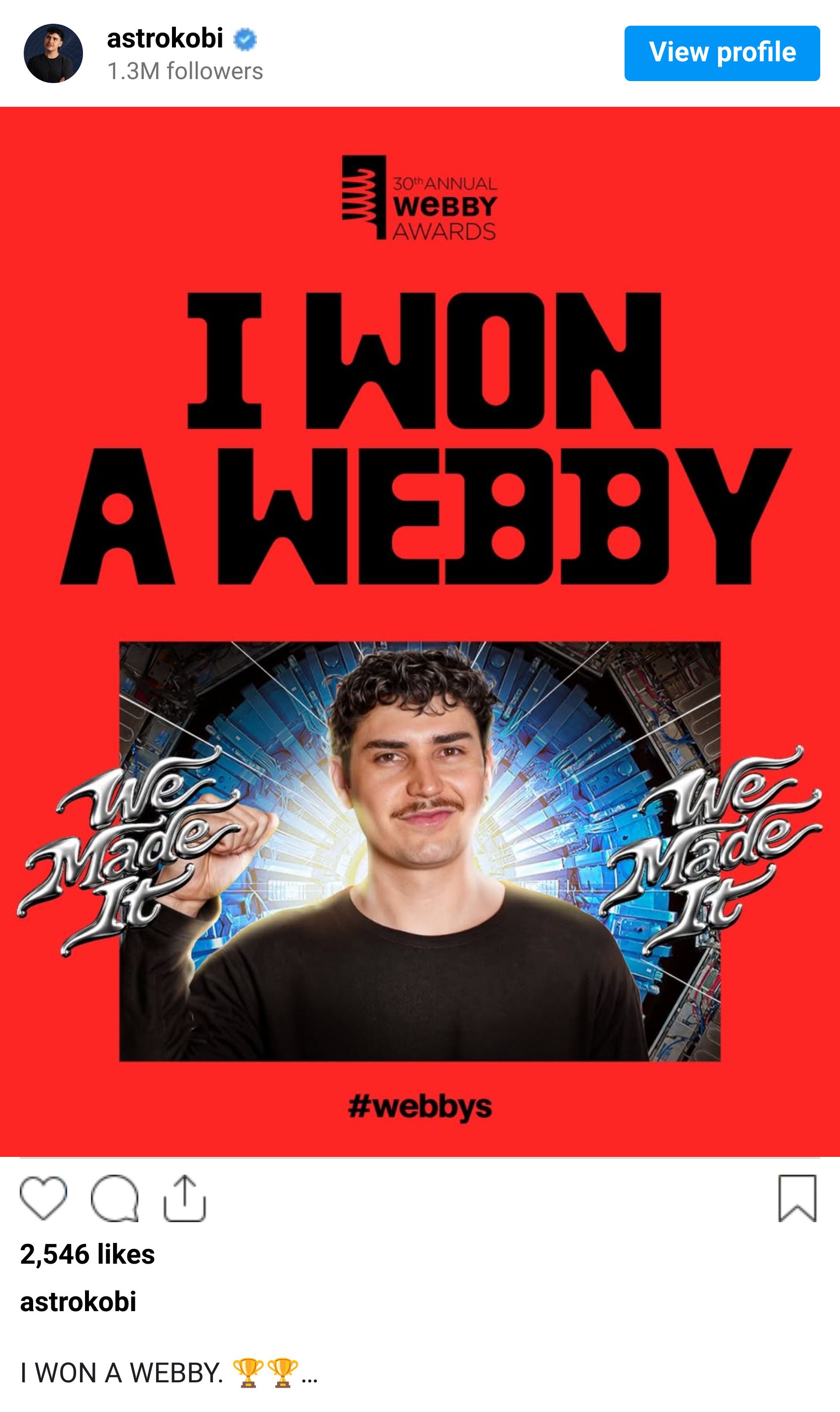
"Science is the closest thing we have to real magic," he writes in an Instagram post (celebrating his recent Webby win).
“In a world full of noise, there is still a massive, global audience of curious minds who want to understand the cosmos. There’s an appetite for creators and science communicators who treat their audience like the intelligent, wondering humans they are.”


A few notes on legitimacy and trust
Last Friday, I wrote about how creators build trust from the bottom up. Values, made legible, proven consistent, and defended even at cost — until an audience sees you as part of who they are.

Originally published in our June 5, 2026 issue. Designed by Laura Calle Puerta.
Kobi is a near-perfect case study. As a science explainer, he sits squarely in what I called the analyst archetype, where the whole product is their read on reality. He's now pushing into practitioner territory by reporting from inside the field.
Three of his moves climb the trust ladder.
Access is legibility you can't fake. About 18 months ago, generative AI began flooding the niche with what Kobi calls "slop," eroding the very things that once set him apart: slick visuals, a clear style. What it can't emulate, however, is him standing inside a NASA facility, or watching a telescope's first images come online in the Atacama Desert before they're public. Being in the room is how he makes the values underneath everything visible — I'm showing you what's actually true. A scraper-type creator wouldn’t be in the room.
A verification layer keeps you consistent — and right. Kobi runs his videos past a network of working scientists, many of them friends met while studying. Consistency, in our framework, is legibility repeated over time; in a feed full of confident, wrong AI summaries, being reliably accurate is the whole game. Trust compounds every time you're right, and collapses the first time you're confidently wrong.
Walking away is accountability. This is the rung that costs you something. When the internet decided an interstellar comet might be aliens, Kobi explained what it actually was and left the follow-ups — and their few million easy views — alone. He held his stated value at the exact moment bending it would have paid.
The top rung, belonging, is what the audience hands back — and "education for all," a line that's lived in his bio since before anyone was watching, is the core value at the base of his ladder.
Years of making values legible, consistent, and proven under pressure have turned Kobi’s following into an audience that sees the world through his work.
