


The now-popular style of fancy, shot-on-location video podcasts is not cheap to produce. To offset the cost with ads alone typically requires many thousands of regular listeners.
Or … you could use the podcast for research and development and marketing for a creative services agency, as Gabriel Ornelas does.
In this episode:
— Francis Zierer, Lead Editor
Your readers are about to fill their carts. Will you get paid for it?

During last year’s Black Friday and Cyber Week, MagicLinks creators earned nearly 3x their average daily commissions.
Your audience is about to buy the gifts, gear, and gadgets you already recommend. The question is whether those recommendations pay you.
MagicLinks makes that easy. One account gets you access to 5,000+ brands at commission rates MagicLinks secures for you, so you can spend less time managing partnerships and more time growing your business.
Find a product or retailer, tap the MagicLinks extension or app, and paste your link anywhere
Clicks, sales, and earnings tracked in one dashboard
One monthly payout across every brand
Don’t miss out on the Black Friday earning opportunity — join the MagicLinks network today. Apply to MagicLinks →
This is sponsored content.


Podcast as loss leader
Gabriel Ornelas told me he has lost “tens of thousands of dollars” producing his podcast, On The Pass, since he published his first episode around the start of the pandemic. The show involves Gabriel conversing with “icons and innovators” across the hospitality industry: think chefs and hoteliers.
What started as an audio-only production during COVID is now a high-production-value, shot-on-location video product.
“At bare minimum, we're looking at $6,000 to $8,000 to do an episode, which in one regard you could say that's expensive, but you know, I know productions that are $25,000 to $30,000 an episode.”
On average, six people touch an On the Pass episode throughout the production process:
Two to three people shooting the episode
Gabriel and his Chief Content Officer (Tim Duffy)
Audio post-production (Dylan Agajanian)
Primary editor
Why is he spending so much money? Because it’s working. For one, people are listening.
On The Pass is a top 1.5% show according to Listen Notes, which tracks active podcasts (currently at least 3,836,058) and their relative performance. On YouTube, episodes routinely draw thousands of views. And at the Signal Awards last month, the show won three golds (including Best Video Podcast, Brand Storytelling) and one silver (Best Indie Podcast).
Producing a great podcast is “not about money,” he said, but money provides access to gear and post-production talent that can give a great concept an edge. A high level of production, too, can make it easier to attract marquee guests for an interview show like On The Pass.
The people listening are largely a mix of hospitality professionals (60–65% of the base) and “deeply passionate” consumers who might travel based on the Michelin guides.

Another reason it’s worth spending so much money to produce the show? It’s a loss leader for an agency by the same name, On The Pass Studios, meaning that money spent on the show comes back through agency business.
Gabriel estimates that around 10% of his business’ revenue comes through the podcast, via sponsorships, underwriting, or events. The other 90% or so comes in through the agency — through their creative services business.
“We're lucky; we have a really substantial audience. But this is never going to be a Huberman or a Diary of a CEO level of 10 million downloads or listens a month. The riches are in the niches … and we have a very powerful community.”

Podcast guests; agency clients
Among any number of reasons On The Pass works as a show and a business is that, before launching it, Gabriel spent over a decade working at the intersection of marketing and hospitality. He’d already built the network and reputation needed to invite industry luminaries on his show and ensure they’d be comfortable and candid.
“I'm a marketing guy. I'm a story guy … I spent, you know, 10 to 12 years working with Faena Hotels and SBE and Thompson Hotel Group and Bacardi, literally working on heads in beds, butts in seats, what everyone's now calling ‘building an audience,’ building a community through experiences, through branding campaigns.
And so this was always the space that I played in. Now, I'm building a platform myself.”
His creative services business is an extension of the work he’d already been doing. The podcast launched in earnest in March 2020, and the agency followed in September 2022.
There’s overlap between the show’s guests, industry-insider audience, and the agency’s clients. This is key to the whole operation: a PR person pitching one of their clients to come on the show sometimes turns into a guest booking, sometimes turns into an On The Pass Studios client.
As an example of the work they do — that 90% of his business’ income — Gabriel mentioned a seven-month campaign with Zwiesel Fortessa, a premium glassware and tableware company. On The Pass Studios was hired for a “multi-event experience at the launch of their showroom.”
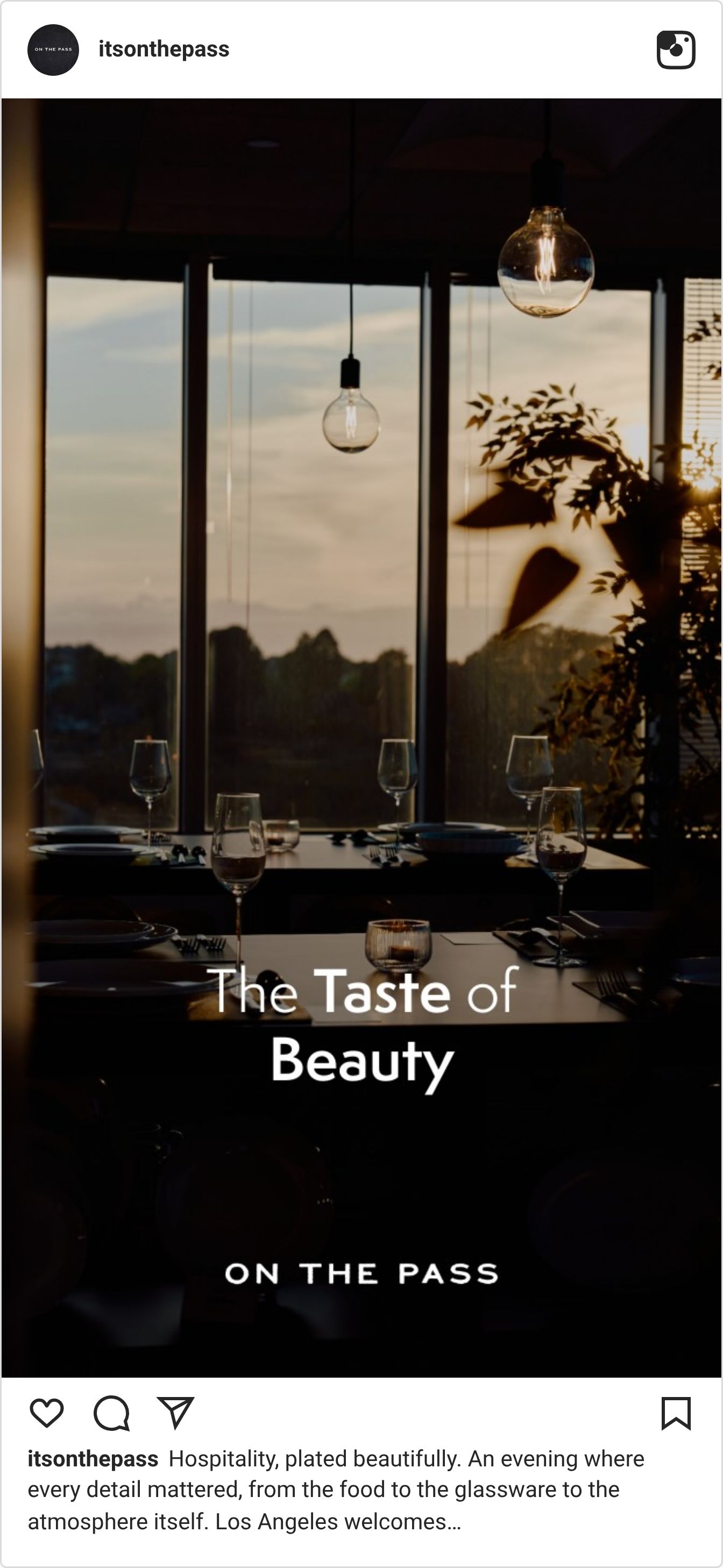
This involved bringing in top chefs and a bar team to work the event, and filling the room with media and industry professionals as guests. Of course, they were also asked to produce video content around the event and promote it all on social media.
Though creative services and campaigns are their bread and butter as of now, Gabriel says his goal is for creative services to become a smaller portion of revenue over time, ceding share to advisory work for other studios, more events and in-person experiences, and a bigger On The Pass network.
Historically, On The Pass has released a new episode every two weeks, publishing typically 20–30 episodes per year. But there are breaks — the most recent episode, with chef Dominique Crenn, went out last week, nearly four months after the previous.
Podcast industry best practices are to stick to a regular schedule and never veer, for fear of losing a listener’s routine to the millions of other podcasts on offer. On The Pass has not exactly followed that practice, which, Gabriel said, comes down to being able to finance the show.
“Some months, we've been like, you know, we've done great work this year, and the team's a little bit tired and the purse strings a little bit smaller, or we have a big project that comes in that, ultimately, the entire post-production team is focused on delivering for that project.”
The show cedes resources to the agency, as you might expect given the structure of the business.
Eventually, given steady financing, Gabriel says he envisions the show releasing weekly. This might involve other hosts; he believes the brand now has enough trust and reputation among its target audience to live beyond him.
But that financing and those potential new shows won’t come without growth on the agency side. Gabriel sees two ways of building an agency today. The first — not his path — involves working with famous people, drawing on their star power (he mentioned a friend who opened an agency with Shaq).
The second — his path — is “pouring into a community, pouring into an industry.”
“We utilize the podcast as, again, this love letter, this intelligence platform to pour into a community, but then also say, we are also here to service that community as well, from a creative service perspective.”

Learn more about On The Pass or subscribe to their newsletter.
Connect with Gabriel on LinkedIn.

Content as R&D or an “intelligence platform”
Gabriel described On The Pass as a research and development channel, or “intelligence platform,” for his creative services business.
The podcast is a testing ground for formats and workflows he can sell to clients. It’s also a place for him to foster relationships that may eventually be leveraged in client activations; for example, a restaurateur could become part of an activation for a client by offering one of their restaurants as a venue.
Gabriel, through his podcast, creates case studies for On The Pass Studios — proof that his team can produce at a high level and attract the right people to a project. The way On The Pass acts as R&D for client work is not novel.
But I found Gabriel’s framing of the show as an “intelligence platform” to be compelling and useful:
“Let's just call [the podcast] a media platform as an intelligence platform.
So when I sit down with the CEO of Resy or Amex, or I sit down with the CEO of OpenTable, or the CEO of a luxury hotel group, that intelligence that we garner from them, the challenges that they're facing, the difficulties they're going through, the headwinds, also the successes that they're experiencing, how they think about brand building, how they think about building community, of offering memorable experiences — we take all of that knowledge.”
The knowledge gleaned through Gabriel’s conversations is, of course, passed directly to the audience in podcast form. But more importantly for his business, he processes that “intelligence,” bringing it into every agency-side engagement.
“We take all of that experience, and we also get to like call on those individuals when we potentially want to work with them. So I think that's also sort of a cutting edge of like what we get to do because not everybody has access to these individuals. Not everybody has built trust with them.”
What Gabriel describes here is, again, hardly novel. Creator Spotlight functions similarly. Any creator whose work is especially interview-based can probably relate.
The question is: How well are you utilizing that resulting intelligence? How well are you productizing it? Monetizing it?
Personally, I’m especially struck by the media-platform-as-intelligence-platform framing because it underscores that, at Creator Spotlight, we are not using our resulting intelligence to its full potential.
Our episode with Gabriel is our 137th. Nearly half of our currently active subscribers only signed up this year, meaning they’ve likely only seen our last 46 profile-interviews. Is the information in the other 91 irrelevant today? No, there’s a great deal of value in our archive. Which is to say, we have an opportunity to bring the most relevant and useful bits from that archive forward for newer subscribers.
I have a few specific ideas for how we’re going to make Creator Spotlight a better “intelligence platform” in the new year. Stay tuned.
And ask yourself: Am I providing the most effective available paths between my audience and the information I’ve collected?
