

Brought to you by beehiiv.
The creator economy is not a purely online phenomenon.
Particularly over the last year, we’ve found more and more of the people we interview for Creator Spotlight are throwing meetups, happy hours, and conferences. They’re hosting retreats and organizing panels.
One of the clearest signals we’ve seen that a creator’s community has real depth is if people show up for one of their events.
I’ve identified four main categories of creator event.
— Natalia Pérez-González, Assistant Editor
The business of showing up

It's 7:45 pm. Your panel ended fifteen minutes ago, and nobody wants to leave.
The crowd has splintered into small clusters near the bar, by the windows, and in the center of a room now loud with talk and laughter.
In 2025, creators, podcasters, and authors sold 500% more event tickets than in 2024, with tickets priced roughly 40% lower than those for traditional live entertainment.
Over the past year, we’ve interviewed several creators who’ve integrated events into their revenue streams. The most successful event programs we’ve seen are extensions of that creator’s core mission, values, and product — whether that’s education, access, identity, or belonging.
Done right, these can be packaged into a repeatable format, generate revenue, attract brand sponsorships, and accelerate community growth.
When I spoke to Jay Clouse, founder of Creator Science, he described community as a living thing, with a pulse to be monitored.
"A community almost feels like an extension of you. You can feel when it's doing well, you can feel when it's a little bit sick, you can feel when it's hungry, you can feel when it's bored."
I’ve identified four main creator-event models, each with different economics, audiences, and demands on the host:
Community meetups
Panels, mixers, and educational events
Flagship conferences
Retreats/premium experiences


Define your event model
You’ve been to an excellent media or creator event, and you want to throw one of your own.
What makes these events feel alive is a great host, a tastemaker. We love parties that cater to our sensibilities — our affinity for a curated atmosphere: music, visuals, food, energy, the elements that make an event memorable.
Before you book a venue, you need to have a solid understanding of your value proposition:
What type of host are you?
What are your main goals and mission?
What do you want your community to take away from gathering in person?
Knowing what type of host you are is key to knowing which event formatting works best with your style. I’ve identified four types of host — Tastemaker, Connector, Architect, and Educator.

Brett Dashevsky, founder of Creator Economy NYC, makes his living throwing events for New York’s creator community. An expert host, he looks to the every-touchpoint approach of a Disney theme park for inspiration.
"Good hosting is not even recognized. It’s just felt. When you go to Disney World, you don't feel all the things. You just want to be part of that flow — the drinks, the team, the vibe. Everything feels natural, and people just leave thinking: that was great."
Community meetups
These are the most accessible starting points. Intimate by design — usually 30 to 100 people — they prioritize recurring connection over one-time spectacle.
Colin Rocker, creator of For the Firsts, a club for first-generation professionals in New York City, runs this model; monthly events of 50 to 60 people, built around guided prompts and open networking at a community space in New York’s Tribeca neighborhood. The end goal is always belonging.
"I always try to get to a point of accessible intimacy. At a traditional networking event, when someone mentions they have multiple kids, I'll ask them: who's your favorite? Because I usually get a real answer. And now we're in a different conversation — one that doesn't involve what year we graduated or what our major was."
Colin’s community meetups run on a tight structure:
The first 30 to 45 minutes are for arriving and mingling.
Then, he introduces himself and sets some ground rules: no job titles, no pitching, and be who you are, not what you do.
Afterwards, the room breaks into two rounds of prompted small-group discussions, followed by open networking for the final hour.
He consciously avoids calling these networking events — he wants people to feel like they're joining something ongoing rather than attending a one-off. The distinction is subtle, but it shapes who shows up and how they show up.
After a year of monthly meetups, he's now building toward a three-pronged model: a recurring meetup for connection, panel and fireside chat events for learning, and workshops for people ready to go deeper.
"I think about events like a form of media," he tells me. "I want to create something where, the same way as with certain shows — like Hot Ones — a brand can get inside there and make it their own. I want to do the same with For the Firsts."
Panels and mixers
A work-and-play formatted event, this is the most sponsor-friendly of the four. Typically, this maps out as a 45-to-60-minute moderated panel on a relevant industry topic, followed by open networking.
The panel is the draw — it gives your audience a reason to come, learn from notable industry leaders (who often have their own engaged communities), and a shared reference point for starting conversations. But the mixer is the real value.
Brett hosted his first Creator Economy NYC gatherings at a Lower East Side bar in January 2023; more of a casual community meetup at first. He’s now logged over 8,000 RSVPs for his events, developed a panel-and-mixer model, and landed year-long brand deals with companies like Teachable, beehiiv, and Notion.

For each event, Brett picks a theme, usually in partnership with a presenting sponsor, and curates the room himself — reviewing every RSVP against the event's theme and the sponsor's goals. He has a small team that runs check-in, an entrance activation, and a panel before stepping back and letting the networking take over.
He doesn't charge for tickets — he wants to keep the events free for his audience — so he never does an event without presenting partners, who pay anywhere from $20–30k per event, enough to cover the cost and keep operations running.
He offers two sponsorship tiers:
Presenting partner — brand name attached to the event title, editorial input on the panel topic, featured in all graphics and the newsletter, and access to the RSVP list
Supporting partner — brand presence at the event (signage, swag, product sampling), mentioned in promotional materials, with less editorial involvement
"Events in and of themselves are not a conversion place. You're building affinity and awareness. Brands are choosing to partner with us because they see this trust and this brand they also want to be associated with."
Olivia Owens, Head of Product Marketing and Partnerships at Teachable, shared what that trust looks like from the other side of the table. Teachable has been investing in creator events for three years, including Brett’s, and for them the core insight is simple: audiences don't want to hear from brands, but they do love to see a brand supporting a creator they follow.
"When we're evaluating an event partner, it's got to make sense. Are they a user of our platform themselves? Is their community a potential opportunity for us — could they be Teachable users? And does the creator have a clear understanding of who their audience is? They should be able to speak really specifically to that."
That specificity is what separates a pitch that lands from one that doesn't. She tells me the creators who stand out come to the table with:
Knowledge of who the brand is investing in
An understanding of the brand’s competitors
A real opportunity to connect with their target audience in a unique way
The data points to back up their pitch
The most successful Teachable activation at a Creator Economy NYC event, in terms of brand-creator-audience integration, was a series of mini expert sessions: community members with Teachable courses led 15-minute presentations on their area of expertise.
"The through-line was they were teaching something — a nod back to Teachable. The people who spoke have Teachable courses. The brand integration was really natural."
The best brand presence at an event doesn't feel like a brand presence at all.
Flagship conferences
These annual events become destination experiences for a community, and it’s the format that requires the most infrastructure, the most lead time, and the most willingness to involve other people.
Video Consortium is a global community connecting nonfiction storytellers. One of their flagship events, the Future of Nonfiction Video (FoNV), is a yearly conference hosted at Columbia University. It brings together documentary filmmakers, video journalists, and content creators who wouldn't ordinarily be in the same room — a deliberately cross-disciplinary mix that shapes every programming decision.
The conference began as a community first, a bar gathering of a few nonfiction storytellers ten years ago, and the conference grew from the relationships inside it.
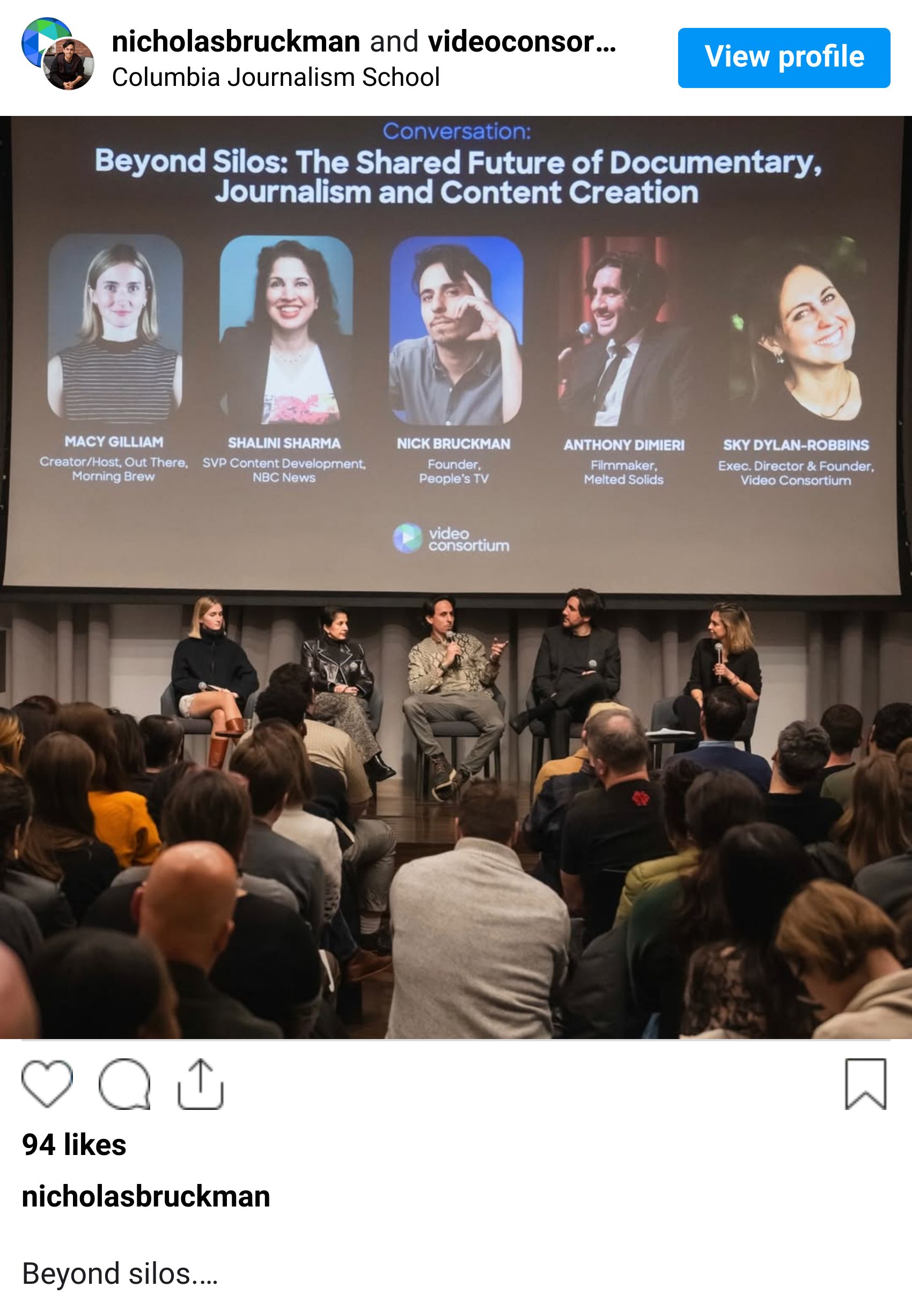
Maggie Piazza Carroll, Manager of Community Gatherings and Engagement at Video Consortium (VC), is the conference’s lead event coordinator.
Through their Slack community, surveys, and Instagram, she gathers what the Video Consortium community actually wants, then builds a dense spreadsheet of ideas, finds the cross-cutting themes, and maps people and organizations to each one.
"We'd even reach out to people who were consistently posting interesting ideas and say: would you want to turn this into a session?" The result is programming that feels specific, curated, and earned.
Maggie runs FoNV with a scrappy team:
A community coordinator
A comms lead
An on-site coordinator at Columbia
Hub leaders from around the country.
She deploys a network of volunteers in lanyards during the event so attendees know who to ask for help, prioritizes good food, and does a full debrief — internal team review, then attendee survey — immediately after every event.
Energy pacing matters more at conferences than at any other format, especially those that run for multiple days. "You don't want a bunch of slower things back to back, or things that are too high energy," Maggie said.
On Sunday, the final day of the conference, the programming moved from a meditation, to a higher-energy activity, to a medium-energy close — a deliberate arc designed around how people feel at different points in a long event day.
Retreats and premium experiences
This is often the highest-trust, highest-ticket model.
Retreats give people concentrated, unstructured time with each other, in a place they traveled to get to, with nothing else competing for their attention.
Jay Clouse has been building communities for creators for almost 15 years. He built his company, Creator Science, with the premise of helping professional creators run better businesses. The Lab is the community arm of his business — a private, curated network of professional creators sharing results in real time.
Last year, he hosted his first major in-person event for Lab members.
On the itinerary: two days in Boise, Idaho, for 40 of his Standard and VIP members.
Planning sessions in the morning.
Small group masterminds that shifted every 16 minutes.
Seating charts designed specifically so the right people would be next to each other each day.
An escape room in the afternoon.
Dinners with the whole group in the evenings.
He priced tickets to cover costs — food, venue, and programming — not to draw a profit. "I think about our events as a member retention and attraction mechanism rather than a profit center for the business," he told me. His Standard membership in The Lab runs $1,999 per year; VIP is $3,999. The retreat is part of what justifies those prices.
Jay's framework for every programming decision was simple: "Is this something that takes advantage of the fact that we're in person? Or could this be done online? Because anything that could be done online, we shouldn't do in person."
This is why, he argues, most conferences are terrible products.
"You sit in the audience, and you watch a presentation for hours surrounded by people you'd love to have a conversation with, but the environment is not conducive to doing so."
Jay’s Boise event was built almost entirely around conversation; no presentations, everything in groups of eight or fewer. His main goal is to create what he calls collisions between people, serendipitous connections that couldn’t have been engineered online.
This year, he's likely to add a title sponsor, which will let him invest more in the experience without raising ticket prices. That's the mature version of this model: events as a membership benefit, underwritten by a brand partner who wants to reach a curated room of professional creators.
The format you choose should ultimately align with your audience's needs:
Colin's community craved belonging and a different way to connect
Brett's community craved tactical knowledge and industry relationships
Maggie's needed a space where nonfiction storytellers across disciplines could work on the future of their craft together
Jay's wanted concentrated time with peers at the same career stage
