

There aren’t many attorneys specializing in creator law.
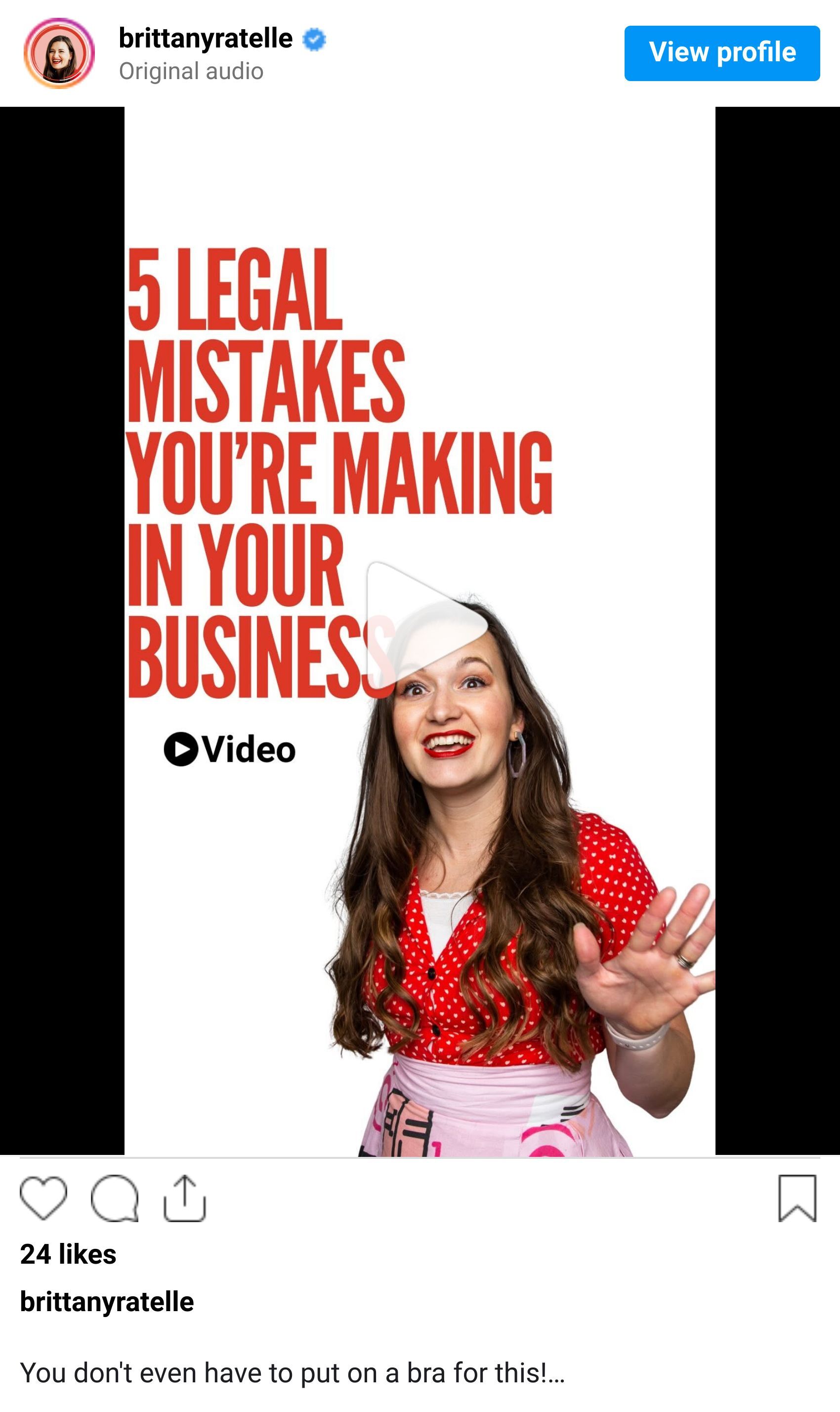
Brittany Ratelle is a business attorney who has spent the last decade growing her practice in lockstep with the creator economy
She represents YouTubers, podcasters, course creators, and e-commerce brands. For those who can’t yet afford custom legal work, she also sells contract templates.
We sought her out to learn a bit of the basic legal details every creator should know.
In this episode:
⚖️ The contract clause that could protect you from a brand's PR disaster
💰 Why your email list has a dollar value (and your follower count doesn't)
🔏 How to redline brand contracts like a creator attorney
— Natalia Pérez-González, Assistant Editor
P.S. Nothing Brittany states in this podcast is formal legal advice, only anecdotal knowledge gathered from her work.

00:00 Introducing Brittany Ratelle
01:26 Biggest red flags in brand deal contracts
10:15 Avoid these contract mistakes
16:06 When should creators formally become a business
20:17 When is reaction content and remixing IP theft?
26:12 The only way to actually own your audience
33:44 How to write a contract as a creator
37:45 Hiring as a creator
42:37 Most common mistakes creators make, legally
45:10 What’s changing for creators in 2026
🎧 If you prefer a podcast platform other than YouTube, we’re on Apple, Spotify, and all the rest.

beehiiv is hiring a Social Media Lead (remote)
Creator Match is hiring an Account Manager (remote)
Fallen Media is hiring a YouTube Series Lead (New York City)
Odd Lots (Bloomberg) is hiring a Podcast Editor (New York City)
Are you a creator hiring someone for your team? A business hiring a creator? Do you want to advertise an open role in Creator Spotlight? Reply to this email.


The fine fine print
In September 2020, model and actress Molly Sims published a sponsored blog post promoting a $112 eyebrow gel. Seven months later, she was named in a trademark infringement lawsuit over the product’s name.
Molly argued she was just an endorser and thus not responsible for vetting trademarks. The judge disagreed. The case settled quietly, but the precedent stuck: influencers can be held liable for what they promote.
That’s a risk Brittany Ratelle, a business attorney who has spent the last decade specializing in creator law, thinks about every day.
Most brand contracts include a morals clause — language that allows the company to terminate if you embarrass yourself publicly. Shouldn’t creators have the same protections?
"What if we have a Balenciaga situation? What if you, brand, are the one embarrassing me? What if it turns out that you have sweatshop labor and someone does an exposé story on you next week? I also want to be able to drop this deal and walk away."
This mutual morals clause is one of several terms Brittany routinely redlines in creator contracts. She calls the details she finds herself negotiating most often the "big three":
Payment terms
Usage rights
Exclusivity
Over her decade of practice, Brittany told us, the industry has matured. Contracts have grown more sophisticated. More creators have advocates — agents, managers, attorneys — who review deals before they sign.
In earlier days, she saw a much wilder arena. Contracts weren’t yet specialized; they were stitched together from older commercial talent agreements, peppered with clauses that made no sense for how creators do business. She's seen requirements for million-dollar vehicle insurance policies on brand deals that didn't involve cars. Payment terms stretched to net 90, sometimes net 180.
"Net 180 — a celebrity marriage has started and ended within the term of this contract."
Now, net 30 is more standard. But payment terms mean nothing without enforcement. She's written plenty of payment demand letters, and sometimes, just getting CC'd on an email with her law firm's name has magical powers. "Suddenly, we found the check."
The more dangerous risk for growing creators, Brittany says, isn't brand contracts, but becoming an employer. "Once you start hiring and having a team, if you're going to have a legal problem, that's probably it,” she told us.
For example, misclassifying a contractor as a 1099 when California law requires a W-2 can trigger a substantial bill for back taxes, penalties, and labor law violations. Brittany has helped clients after they've received those letters — and while there's room to negotiate and settle, "you're gonna have to pay something, and it definitely is gonna suck."
Her advice: if someone is truly an independent contractor, they should be invoicing you, ideally have their own LLC, and operate like a service provider with multiple clients. The more the relationship resembles employment — set hours, mandatory unpaid trainings, exclusivity — the more exposed you are.
Platforms work the same way. Brittany reminds creators that social media accounts exist on rented ground. When The Onion bought Infowars in 2024, they assumed the sale included the social accounts. X blocked the transfer, citing its right to approve account transfers. Most platform terms of service include similar language.
"You are a tenant, and Zuck is the fief lord of your kingdom. Most of the time your incentives align, so you're not that worried about it. But every once in a while, you've got to get your head up out of the trenches and remember — I don't own this."
In merger and acquisition deals Brittany has worked on, she tells us email lists tend to receive valuations from accounting firms where social accounts might not. Social followings don't carry the same weight — the asset is too amorphous, often too tied to a single person, too dependent on platform approval to transfer.
"There is an actual value you will get for your email list. Followers in the social media account? Not given the same weight."

Contract clauses beyond the “big three”
A few other clauses Brittany routinely redlines:
Deliverables should be specific. "It used to be a lot more open-ended — 'one post' — and I'm like, what does that mean? Is it a carousel? Is it a Reel? What is the length?" Ambiguity benefits the brand, not you.
Revision rounds should be capped. One consolidated round of revisions, written into the contract. Open-ended revision language invites scope creep.
Morals clauses should be mutual. Standard contracts let brands exit if talent misbehaves. Brittany adds reciprocal language: if the brand faces a scandal — discrimination suits, ethical violations, PR disasters — you can terminate immediately.
Connect with Brittany on LinkedIn and Instagram.
Learn more about her services.
Browse her contract templates.

How to redline brand contracts like a creator attorney
Brittany reviews hundreds of brand deals annually. Her negotiation approach centers on the “big three” details present in most detail — and the places where she most often sees creators leaving money on the table.
Understanding these three areas is crucial, especially if you’re reviewing a brand contract without legal representation.
Payment terms
Net 30 is the industry standard — an agreement that the brand will pay the creator within 30 days, typically upon delivery of final assets. Brittany will sometimes counsel clients to accept net 60 for a lucrative deal, but net 90 and net 180 are walkaway terms.
Her non-negotiable addition: To ensure clients get paid on time, Brittany will add a late fee clause, typically 1.5% per month, or "the highest statutory interest rate applicable in this jurisdiction." That caveat matters — she negotiates contracts under California, New York, Michigan, and Illinois law, and rates vary. Without enforcement mechanisms, payment terms are just suggestions.
Usage rights
There are two services you're selling as a creator: creative production and distribution access. Many creators bundle both, but price only one.
The industry standard is 30-day usage periods on O&O (owned-and-operated) channels — the brand's own social accounts and website. Anything beyond that — paid media amplification, extended terms, third-party licensing — warrants additional compensation.
One common trap: contracts that specify usage rights but never define the term. If the contract doesn't say when usage ends, assume it doesn't.
"They'll name the usage rights, but then the term won't be defined. And there are sometimes ways — they have their own attorneys on their side advocating for them."
Exclusivity
An exclusivity clause prevents the creator from partnering with a similar brand for a set length of time around the deal.
Brittany’s hardline: Make brands explicitly name their competitors. Don't accept language like "you can't work with any of our competitors for three months."
"I don't know who that is, and my list might even be bigger than their list."
For brands selling diverse product lines, narrow by category. A craft creator partnering with a company like Fiskars shouldn't be locked out of all scissors, markers, and paper — just the specific product featured in the campaign.
Exclusivity has real opportunity cost; factor it into your rate, or negotiate it down.
One final note on negotiation strategy: if a brand pushes back on rate, resist the urge to drop your price. Instead, adjust deliverables, trim revision rounds, or narrow exclusivity. Protect the rate.
"Once you've lowered your price, they're going to remember it. People move around in this industry, and you've anchored yourself."
