

A beehiiv production

The creator economy does not exist solely on the internet and in our phones. Every city produces a different kind of creator, shaped by its industries, institutions, neighborhoods, and culture.
Last year, I put a magnifying glass to the thriving creator economy in Chicago. Today, we’re applying the same lens to Boston.
— Natalia Perez-Gonzalez, Assistant Editor
Run your video channel from a chat window

Open.Video gives you a video channel on your own domain, lets you keep 100% of your revenue, and now connects with AI tools to handle the busy work.
With the Open.Video MCP server, your favorite AI agent can publish videos, write titles and descriptions, optimize SEO, pull analytics, and more. Just tell it what you want.
Already on YouTube? Import your entire channel in one click and keep both running. Every subscriber becomes a real email address you own.
This is an advertisement.
The opportunity for Boston creators, at a glance


“Being a creator is not unlike being an artist. Think about how an artist 100 years ago made their living. You do a lot of things, and you can make it all work."
Creativity is a function of proximity, and few American cities are built for proximity like Boston.
Boston is one of the densest major cities in the country — ideas spread because people are consistently running into each other on sidewalks, in classrooms, at bars, on the train; in the spaces between home and work. Triple-decker homes, like the one I live and grew up in, are often stacked with families; my mother lives below me, in the apartment I grew up in, and a migrant family of four lives above me.
The city’s brownstones are pressed shoulder to shoulder, like old, lifelong friends with mirroring stoops, and lined with cobblestone roads. The country’s oldest subway threads together universities, hospitals, startup offices, and neighborhoods where people have known each other for generations, grown up together, and built businesses together.
Boston rewards creators whose expertise compounds. The city's breakout creators are less likely to be entertainers than translators, publishers, educators, researchers, and cultural archivists — people who build businesses by helping others navigate, experience, and understand the world around them.
By most measures, Boston is the most educated city in America. Massachusetts has one of the nation's highest rates of bachelor's degrees, and Newton and Cambridge rank first and second among U.S. cities for educational attainment.
That concentration of expertise spills into the local economy. Boston-Cambridge is the world's largest life sciences cluster, home to roughly 130,000 workers and nearly $56 billion in venture funding over the past five years. Add the hospitals, universities, financial institutions, and four professional sports teams, and you start to see the city's comparative advantage.
Roughly five million people live across Greater Boston, but the city itself is remarkably compact. It has the third-highest Transit Score in the country and an average Walk Score of 83, making it easy to move between campuses, startups, neighborhoods, and coffee shops without a car. A founder, journalist, scientist, and creator can easily end up at the same bar after work.
That proximity gives Boston a particular kind of creative energy. The city's punk and hardcore movements grew out of basements and all-ages venues. Neighborhoods formed strong cultural identities — Fields Corner's Vietnamese community, Mattapan's Haitian community, Roxbury and Dorchester's Cape Verdean community, East Boston's Salvadoran and Colombian communities.
This is a city of overlapping local worlds, and creators who spend time here rarely run out of stories to tell. They’re also well positioned to turn those stories into specialized businesses.
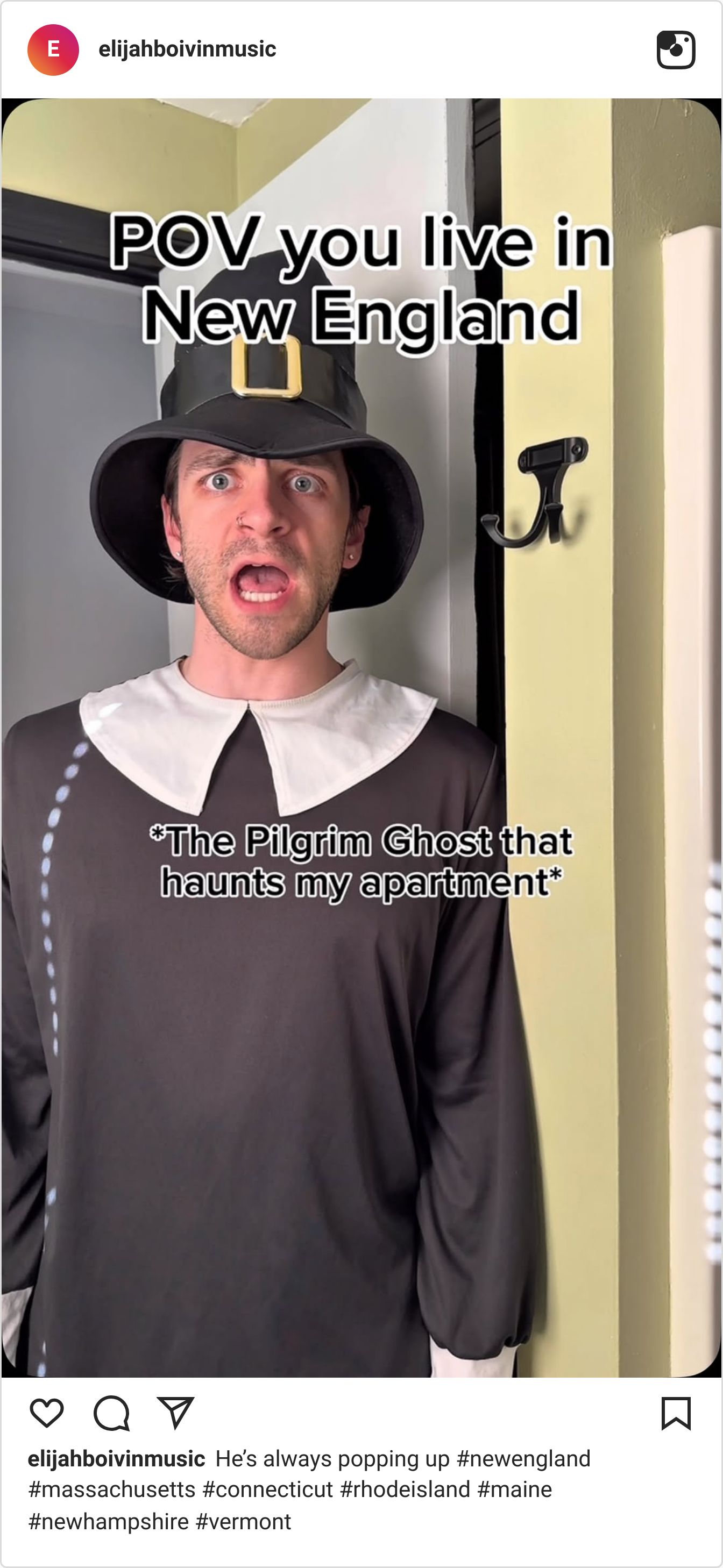
Elijah Boivin (@elijahboivinmusic) makes comedy about growing up in New England — fluffernutters, Dunkin' runs, the specific trauma of a hallway light switch — mostly through a ghost pilgrim character named Bartholomew. His partners have included the Patriots, Gillette Stadium, Dunkin', and Papa Gino's.
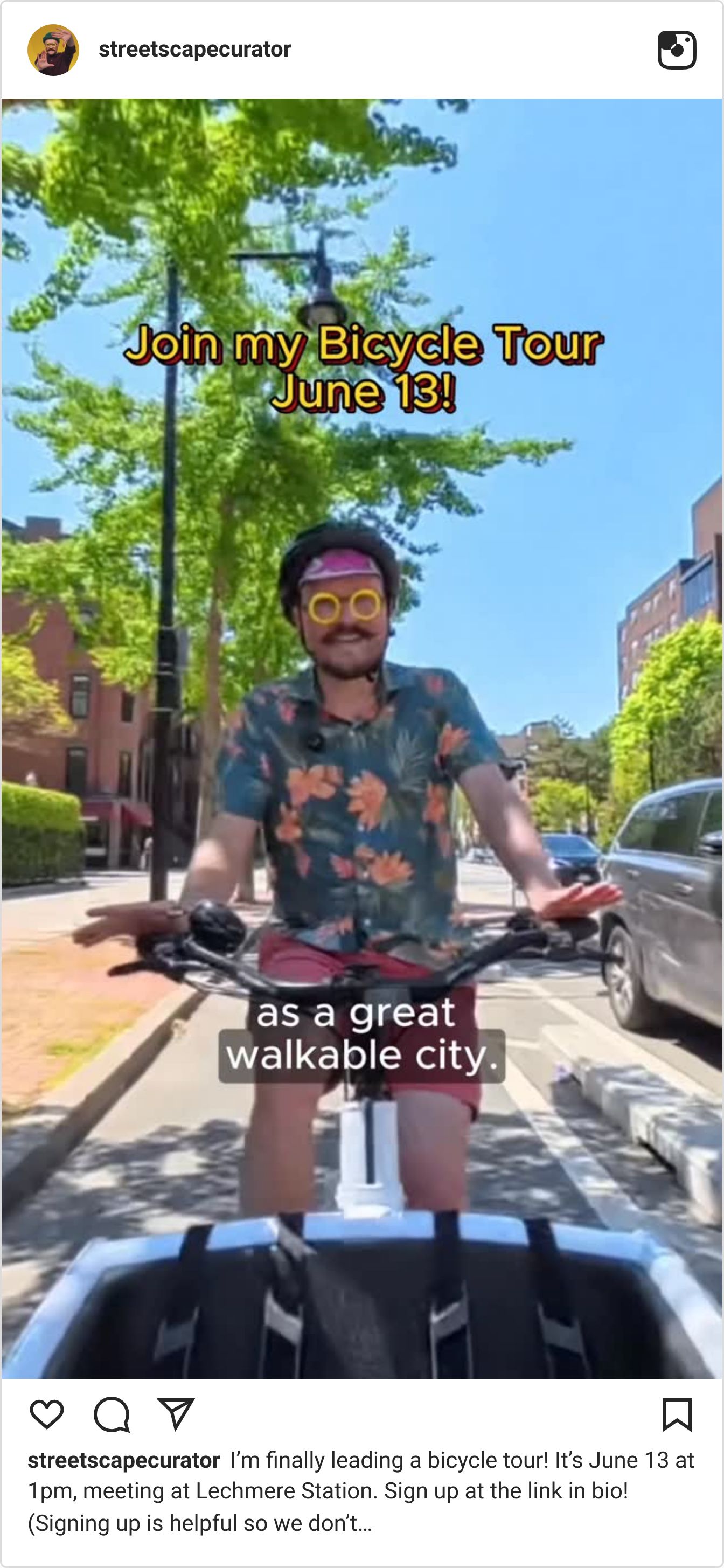
Matthew Dickey (@streetscapecurator), a Boston-based artist, urbanist, and cyclist, bikes the city photographing buildings, connecting his roughly 60K followers to a sense of place. Since quitting his job and going fully independent last November, nearly all his clients have been in the civic world:
A Better City — a business-backed nonprofit that advocates for transportation, housing, and public space in Greater Boston.
Boston by Foot — a volunteer-run nonprofit that has led architectural walking tours of the city since the 1970s.
Visit Massachusetts — the state's tourism office
Leventhal Map & Education Center — the Boston Public Library's map and geography research center, free and open to the public.
The City of Boston's 250th anniversary programming — the city's slate of events marking the American Revolution semiquincentennial, a campaign Kate Bergman, who has run @bucketlistboston for over a decade, also worked on.
Long before anyone talked about creator businesses or owned audiences, the city was often producing publications sustained by engaged, high-trust, tightly knit communities.
On January 1, 1831, William Lloyd Garrison began publishing The Liberator out of a Boston print shop. At its height, it had a paid circulation of roughly 3,000. Around three-quarters of those subscribers were Black, and free Black communities in Boston and across the North funded it directly. Black women in the city ran the fundraisers that got the first issues printed, and William employed Black subscription agents to build the list.
By any modern metric, it was a small newsletter. Most importantly, it became one of the most influential abolitionist newspapers in American history. This model, a small, engaged audience, funded directly by the people it serves, is one Boston creators are still using.
This is the spirit of Boston: gritty, resilient, combative, and fiercely loyal.

Small audience, big business
On a notably cold week in January 2024, a TikTok by Boston’s Mayor Michelle Wu popped up on my FYP.
It was among the first posts in a TikTok series she’d called "Commute with Me," where she’d join Bostonians on their daily commutes to work. I watched as she stood by a ninth-grade teacher named Becky, who tracks the 501 bus on her phone, waiting in an unheated shelter.
@officeofmayorwu Commute with us! I’m joining Bostonians on their daily commutes to experience all parts of our transportation system & how we can do bette... See more
Within hours, the video went viral, and Bostonians praised the campaign for its clever way of raising awareness of the city’s various commuting obstacles. Other videos in the series went on to cover speed humps, how to get the most out of a Boston Bike Pass, and MBTA closure reminders in English and Spanish.
As more of the videos took off, city officials began to adopt content creation into the municipal communications strategy.
On May 6, 2025, the city convened Boston's first-ever Content Creator Summit at the Back Bay offices of Gupta Media, a local advertising agency that co-hosted the event. Somewhere between 75 and 80 creators were present, and Wu worked the room with her infant daughter in tow, sharing with creators that what people consume shapes how their neighbors think about what they're capable of.
Gogi Gupta, the agency's founder, called it "a conversation about the future of economic opportunity and cultural identity in Boston." Boston Magazine read it as a deliberate effort to write creators into the city's story, amplifying the mayor’s message.
Kate Bergman, creator of @bucketlistboston, was among the creators in attendance.
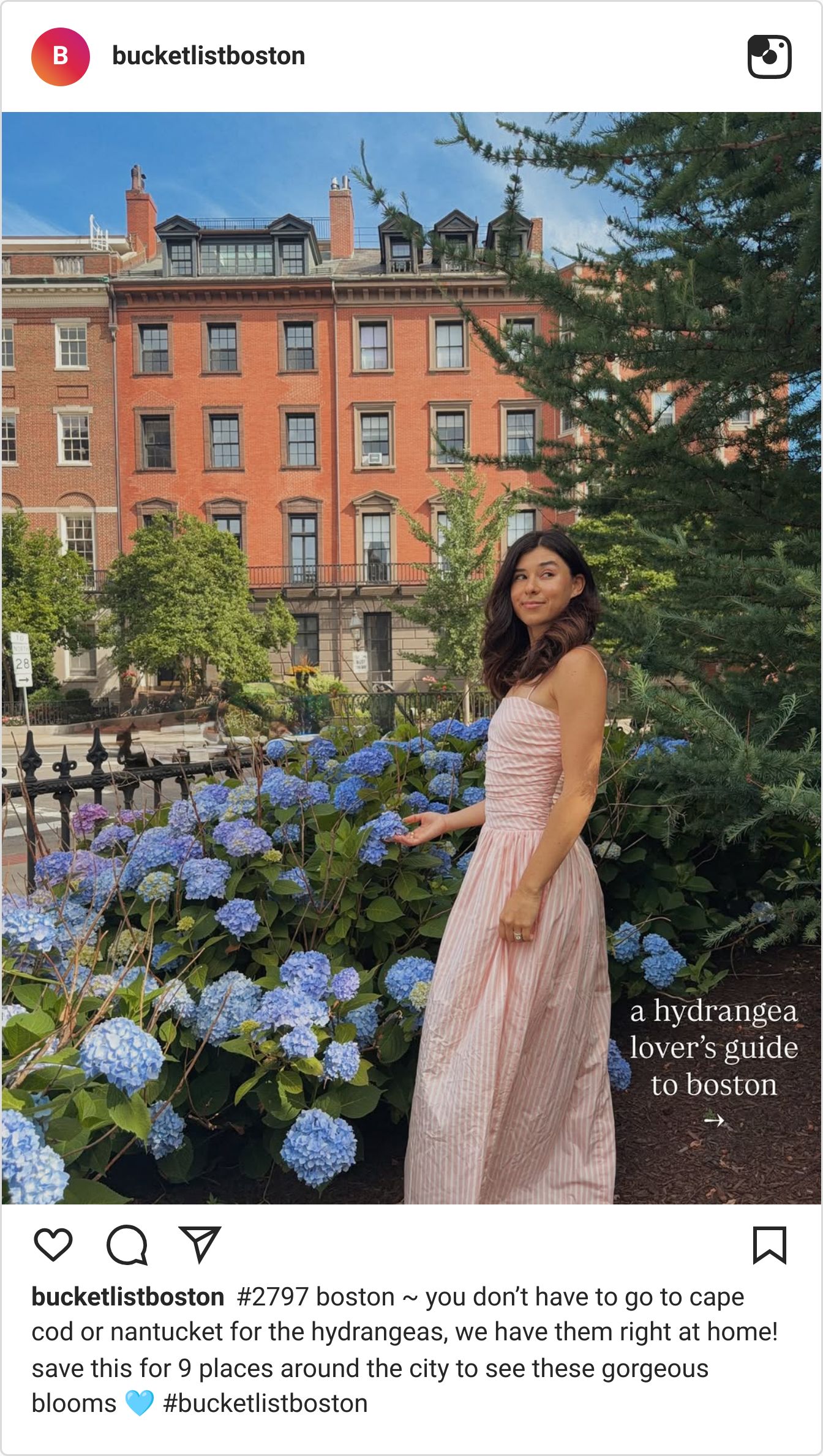
As a Boston University freshman in 2015, Kate had a camera roll full of Boston photos and nowhere to put them. She’d applied to IG Boston, a local photographers' collective you had to be accepted into, and they turned her down three times.
"By the third rejection, I decided I didn't need them anymore," she tells me. "I was just going to post my photos on my own. And that’s how Bucketlist Boston was born."
As she was first building her audience, she promised herself she wouldn't miss a day of posting, and for two years straight, she didn't. "I attribute that to my success in a lot of ways,” she says. “The consistency and the constant flow of new content really helped me grow."
Her page is now approaching 3,000 things to do in the city, and she’s built a website full of thoughtfully curated guides. She’s amassed 241k followers on Instagram, her main platform.
Eighteen months after quitting her job and going all in on her business, she now runs on four revenue streams:
Brand partnerships
Social media and brand consulting for local businesses
Speaking engagements at BU and other universities
UGC, where she shoots for brands
Her production setup is a phone, occasionally a tripod, and a phone grip. "We're a slim team, but we get it done."
Kate’s entire business runs on trust, on her audience trusting her taste and recommendations. Every Sunday, Kate opens a question box she calls “Bucket List Office Hours,” and the questions sprawl in. “Where should I host my bridal shower? What's a good day trip on public transit? What tailor did you use for your wedding dress?”
She answers nearly all of them, most of them publicly, in a full story set saved to her highlights.
"That's the biggest way that I build community and loyalty," she says.
"You start to see the same questions again and again, and you're like, okay, everyone's asking about the best antiquing in Cambridge — so I guess it’s time to spend a day in Cambridge antiquing. It's honestly a really good flywheel. I'm able to garner what people are needing or wanting right now, and then I can feed the wheel on the other side by answering their questions with more content."
Kate is also ruthless about speed. Her husband Teddy often quotes her mantra back to her: “no one cares about Halloween on November 1.”
"I used to have a manager who would overthink every single post, and I felt like we missed the moment dozens of times because of that," she tells me. Her own threshold is to check the caption, check for typos, make sure the timing hits the beat, then ship.
"Maybe if I spend another hour on it, it would get 2% better. But that's not enough that it's worth missing the moment, and it's not enough that anyone would realize the difference. If I showed you both versions, you're not gonna see one as significantly better than the other."
Which is why she doesn't overplan. If it starts raining, she has a rainy-day guide in her back pocket. If the sun comes out mid-storm, she'll stand outside for twenty minutes waiting to see if a rainbow shows, then turn it around fast, because people only care about the rainbow while it's there.

Off the platform, into the city
A common thread among the creators I spoke to in Boston — they’re all avid researchers, captivated by the city’s charm.
Behind Matthew Dickey, on our video call from his Dorchester triple-decker, hangs a painting he made of Gillette headquarters in South Boston, and another of a small gingerbread gatehouse in Savin Hill, the last piece of the estate that gave the neighborhood its name.
Procter & Gamble has since filed plans to replace the Gillette 31-acre campus with a 20-building mixed-use development, a project the Globe reported could take a decade or more to complete.
Naturally, Matthew painted it now to preserve its current form.
"The thing that I love about cities is that they are in constant change," he tells me.
He waxed poetic about Boston’s architecture, about the sense of time and place it creates. City design, he emphasized, should always prioritize humans. "You get to experience so much different urbanism in such a short amount of space," he says about Boston.
Matthew has posted on Instagram, his primary platform, more than 3,000 times; he answers nearly every comment, "because that's what community is." And he is conspicuously uninterested in scaling for scaling’s sake.
"Could it grow more? Could it grow better?" he asks of his accounts. "It's grown the way that it needs to."
"I don't really find that the difference of 60,000 to 100,000 following changes your value or worth when you're relating to brands […] You do not have to post every day. You do not have to do what everybody else is doing. You being you is the thing to be, because nobody else can be that."
What he optimizes for, instead, is getting off the platform entirely. "My favorite moment is when I can take it off of social media and bring it into the real world."
He ran a bike tour for Boston’s A Better City, and fifteen people came — people he'd never met, but who he knew had been engaging with his work for a long time. Fifteen, he says, is the perfect number. More than that and it's hard to move a group through a city.
"It was great to know that I have the ability to bring people together," he says. "That's really what I like the most."
Creators to watch
Emergent communities aside, at the end of the day, it's all about the creators. Nothing is built without people to build for.
After weeks of working on this story, I'll leave you with a few rising stars I'll be keeping an eye on.
— Natalia Pérez-González, Assistant Editor

Matt Shearer | Reporter and creator-journalist
Claudiane Philippe | Lifestyle creator
Keonté Henson | Food grader
Alaina Pinto | New England travel creator
Adriana Lacy | CEO of Influencer Journalism
Cafecito & Chisme | Social club for women and nonbinary folks
