

Brought to you by beehiiv.

Two years ago this month, AJ Eckstein started a creator marketing agency focused on B2B brands and LinkedIn creators. In year one, he facilitated a seven-figure spend between his clients and his creator network.
In year three, that spend will increase tenfold compared to year one.
In this episode:
— Natalia Pérez-González, Assistant Editor
Selling everything, everywhere, all at once: Shopify's Spring '26 Edition

Over 150 updates that put your products everywhere people are buying. Some highlights:
Agentic Storefronts in the Admin: Orders, sales, and conversions from ChatGPT, Copilot, AI Mode in Google Search, the Gemini app, and Shop are all in one view, so you know which channels are growing and where to focus.
Get proactive recommendations from Sidekick: Sidekick Pulse, which turns your store's own sales, traffic, and inventory into your next best actions, now greets you on a redesigned Admin home that puts Sidekick at its center.
Expert marketing in the Shopify admin: Campaign Autopilot runs AI-powered marketing campaigns automatically across Facebook, Instagram, Shop, and email, and uses commerce intelligence to optimize over time within guardrails you set. Now in Early Access.
This is an advertisement.


Building an eight-figure B2B creator agency
In its first year, AJ Eckstein’s B2B creator marketing agency, Creator Match, paid out $1 million to creators. In its third, that figure will surpass $10 million. His originally solo-run business has quickly become a thriving company moving creator budgets at scale.
AJ started out as a B2B creator. His was the first college class to graduate into the pandemic, and when the start date for his San Francisco consulting job was pushed back by six months, he used the unexpected gap to build his personal brand — offering paid career coaching, starting a podcast, and posting relentlessly on LinkedIn.
On his podcast, The Final Round, he interviewed recruiters on how to survive the final stages of a job interview. Naturally, the podcast translated well to a LinkedIn audience, where his following grew and grew (to 58,481, at the time of writing).
Somewhere in that grind, he became obsessed with the B2B creator community. These were people with hundreds of thousands of followers, sometimes millions — "the MrBeasts of LinkedIn," as he puts it — who had never made a dollar on the platform.
What if he managed them?
About three years into a consulting job at Accenture, he banked six weeks of PTO, took a leave of absence to "go explore some entrepreneurial activities," and never came back.
Like many first-time founders, AJ wanted to build an entire ecosystem early on: an agency, a marketplace, a tech platform. And like many of those founders, he realized that in trying to do everything, you do nothing quite well enough. So he settled into one lane: creator marketing, for tech brands, with a focus on LinkedIn.
Once Creator Match nailed that, the business began expanding into multi-channel campaigns across Instagram, YouTube, newsletters, paid media, and in-person events.
This June marks two years in business. In their third year, AJ tells us, the company will deploy millions of dollars a month in creator spend for tech brands like Anthropic, Notion, Lovable, and Perplexity. The team has grown from just AJ and an AI note-taker to 35 employees, several of whom take six-figure salaries. "This is not a side hustle anymore," he tells us. "We have HR."
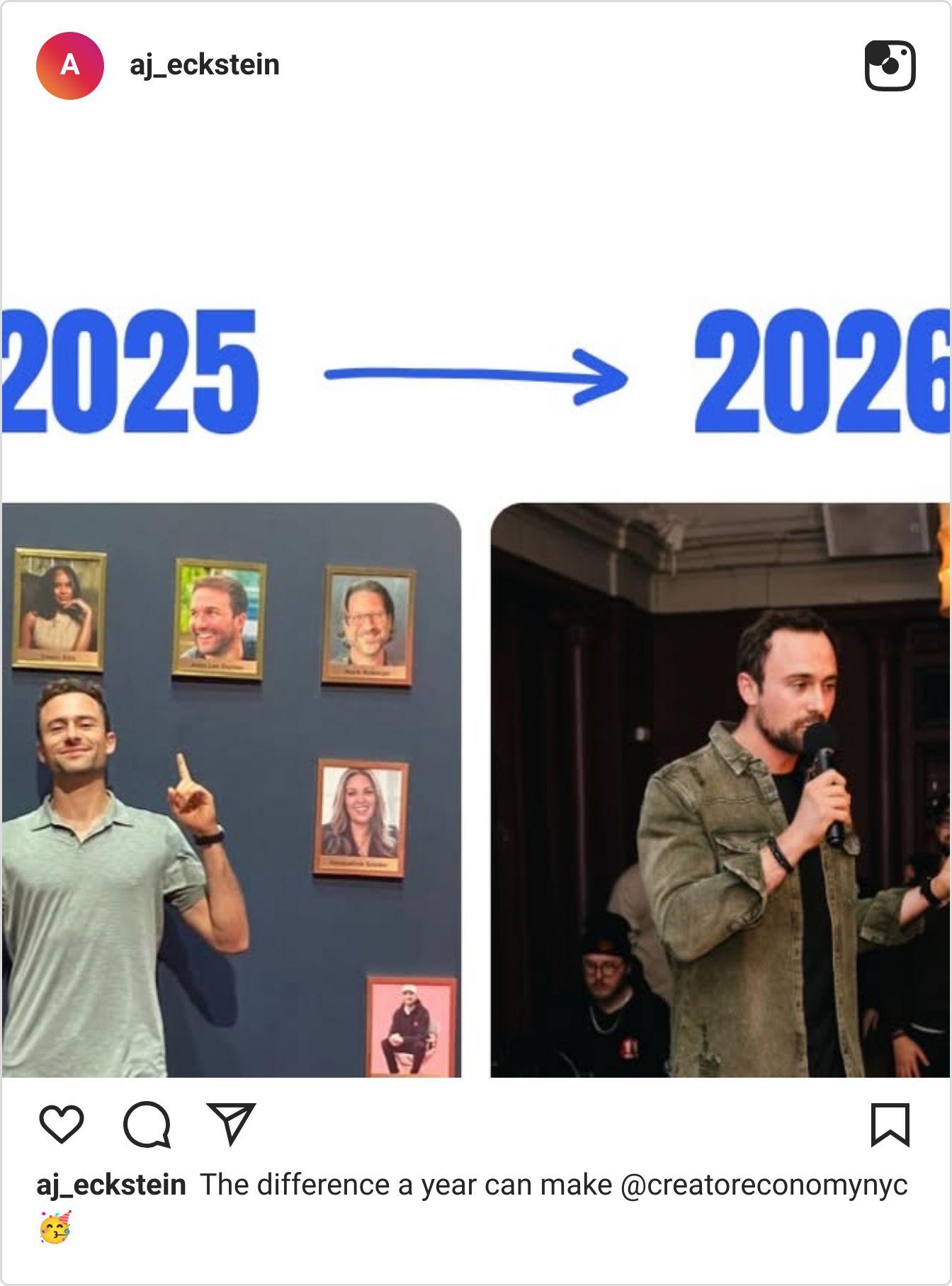

How Creator Match makes money
Every Creator Match campaign starts from a clear goal, usually tied to metrics AJ sorts into three buckets:
Top-of-funnel brand awareness measured against a CPM target
Bottom-of-funnel performance tied to conversions, clicks, or revenue
And a newer one — AI search, getting creators to talk about a brand so it surfaces when someone asks ChatGPT or Claude which product to buy.
Then the brand funds a wallet, anywhere from six to seven figures, tied either to a single campaign or a stretch of time. AJ and his team build a sourcing list aligned with the campaign's goal; they handle rate negotiations, contracts, rounds of revisions, and a wrap report at the end.
From there, Creator Match manages the funds, deploying capital to the right creators as fast and efficiently as it can, and keeps none of it. The agency makes its money on a monthly retainer or a percentage of the budget; the creator keeps 100% of their fee.
@aj_eckstein AI is quietly creating a new class of knowledge workers: the people who build the machine instead of operate it. That’s why GTM Engineer a... See more
Throughout these campaigns, the brand and the creators do not communicate directly; it’s all mediated through the agency.
"We're not your manager," AJ says. "We just send you deal flow."
He's emphatic about why he chose the brand side over representing talent. Managing creators meant being their "financial coach,” sometimes their "dating coach," and living on call at all hours for people who didn't pay him. The brand side, of course, puts him next to the budget:
“It’s just much safer to be as close as you can to the bank account, and then you find the best talent.”
The relationships compound, person by person. The influencer-marketing teams at these tech companies are tiny — even a company the size of Anthropic, AJ told us, runs most of its influencer marketing through one person. So when that one marketer leaves for the next company, they tend to bring Creator Match along. The aim, ideally, is to become a brand's agency of record — a six-to-twelve-month partner spending against a number like $1M across the year, rather than a string of one-offs.
"The business that we're really in is world building. You want to build your world through trusted voices […] the barrier to build has gone to zero ... the only, last moat left is brand.”
Learn more about Creator Match.
Connect with AJ on LinkedIn.

A few notes on landing and retaining B2B brand deals
AJ’s vantage point makes his advice unusually concrete — he decides who makes a brand's sourcing list and who gets cut from it. The whole game, in his telling, is getting on that list, then making yourself impossible to drop.
Sponsoring a creator is riskier for a brand than buying a Meta or YouTube ad, so your job is to take that risk off the table. AJ describes a ladder of proof:
You've made a post about the brand unpaid, and shown that your audience cared.
If you don't have that, the next-best proof is category relevance: you've covered a similar tool or topic, and it performed well.
Below that is general sponsored work that proves you can make branded content people actually watch.
Don’t wait for an agency: Even as an agency owner, AJ advises, "It's in your best interest to fend for yourself and go fish for yourself." Pitch brands directly, build a media kit, and meet as many brand-side agencies as you can. "No one's gonna throw your hat in the ring. You have to throw your own hat in the ring."
As AI floods every feed with cheap content, AJ says storytelling becomes the signal that cuts through the noise. Favor “use-case content” — content depicting the workflow, the prompt, content that earns saves from your audience — over feature announcements.
Price for the second deal, not the first. The goal of any first campaign is renewal. "The money is never in the first," AJ says. "It's in the second or the third." He likens it to an internship: why hurt your shot at the full-time offer? That means pricing against your typical performance — not the one post that went viral. If you sell a brand on an outlier, they'll expect those results to be consistent. Miss that mark, and there may not be a second campaign.
What the Creator Match sourcing sheet tracks
Creator Match tracks a creator network of thousands, sorted on a sheet that describes far more than follower count. A few of the columns that decide whether you make a given campaign:
Reach. You can make the best content in the world, but a brand can't justify sponsoring a creator "getting seen by five people." Some baseline reach is the price of admission.
Format match. If a brand wants video and your feed is all carousels, it’ll be a hard sell for them to justify a sponsored post in your world. Make the format they're buying before you pitch, not after.
Real product use. AJ can spot a fake power user immediately. If you're claiming to love a product you've barely touched, that has never appeared in your videos, it’s obvious and inauthentic; you’ll likely be passed over.
Niche authority. AJ sources by niche — a separate shortlist for sales, marketing, finance — then takes the top few names in each. The goal is to be one of these three or four people a specific audience follows for use cases.
Join the Creator Match network here.
HubSpot AEO

Picture this. A buyer opens ChatGPT and asks for a recommendation in your category. Your competitor's name comes up. Yours doesn't. And that buyer never makes it to your website.
That's happening right now in markets everywhere. And most teams don't know it's happening because it never shows up in their analytics.
HubSpot AEO shows you exactly where your brand stands in AI search, where competitors are getting recommended instead of you, and tells you specifically what to fix. No expertise needed.
Try it free for 28 days. Just $50 a month after.
This is an advertisement.
