

Brought to you by beehiiv.
Stop me if you’ve heard this one before.
A few friends start a free Substack newsletter sharing recommendations from niche internet celebrities. Famous musicians like Charli XCX ask to be part of it. Even Francis Ford Coppola does one!
But the platform starts to feel limiting, so they leave to build their own. Users join by the hundreds of thousands.
This is Perfectly Imperfect. It’s a story unlike any we’ve featured previously.
In this episode:
✌ Why they left Substack and what they’ve built to replace it
💵 How Perfectly Imperfect makes money (and their perfect brand deal)
🦾 Why refusing to optimize for algorithm culture is a strength
Listen wherever you get your podcasts; watch below; and scroll down to read our profile.
— Francis Zierer, Lead Editor


How a free newsletter became a social media platform
By the time Tyler Bainbridge learned he was being laid off from Meta, in May 2023, he’d already decided he wanted to build the next big social platform — one free from hyper-optimized algorithms.
It was the logical next step for his newsletter, Perfectly Imperfect (PI for short), which he’d started with two friends just after joining Facebook as a software engineer in August 2020.
At that point, however, the newsletter was still completely free. Two-and-a-half years in, and they’d never asked a dollar of their readers, nor worked with advertisers.
In the beginning, on September 8, 2020, Tyler and his co-founders, Alex Cushing and Serey Morm, sent the first issue. Recommendations included “Japanese Hip Hop, Cowboy hats, The Great Outdoors, and more.”

The very first issue of Perfectly Imperfect.
Ever since then, Perfectly Imperfect has landed in subscribers’ inboxes about twice per week. At first, besides sharing whatever they were into at the moment, the founders would ask friends to do a feature. Eventually, Perfectly Imperfect began asking people they liked — podcasters, musicians, artists — to do interviews.
Soon enough, they didn’t have to ask; Tyler mentioned a milestone moment two years in when Charli XCX reached out to be featured.
The newsletter’s tagline has changed a few times over the years. “Cool people like cool things,” was an early version. One iteration, “A Taste of Someone’s Taste,” neatly describes the entirety of the project, from the earliest issues to the growing social app; the core editorial product has remained largely the same.
“Part of the Perfectly Imperfect DNA is we can feature Francis Ford Coppola and the Rizzler, and then some random podcaster, and it all works because it's the same format and taste is universal.”

A perfect growth flywheel
In terms of growth, Perfectly Imperfect benefited much from two timing factors.
First, they entered a still-nascent Substack ecosystem at just the right time. When Tyler and his friends sent their first issue back in 2020, Substack was still primarily a newsletter tool and had not added the social media features — followers, Notes — that define the social platform today.
That their trade was sharing what “cool people” were into also helped; other people in the Substack ecosystem wanted to get involved. Emily Sundberg, of the platform success story Feed Me, was the guest for their 23rd issue, just two months in.

Second, they were a New York-centric cultural product just as the city was waking up from the pandemic, capturing this specific brand of lightning in a bottle. Their issues were filled with up-and-coming artists, musicians, filmmakers, writers, and podcasters, forming new scenes in real time.
For this brief, highly energetic period in New York City youth culture, Perfectly Imperfect was a virtual paper of record.
Indeed, the actual paper of record covered them for precisely this reason; when Perfectly Imperfect threw their first party — their first formal foray outside the internet — The New York Times covered it, breathlessly titling the piece “What the ‘Cool Kids’ Are Super Into.”
Twitter ridiculed the headline, but Tyler remembers bringing in 10,000 newsletter subscribers in the two days following publication; they had “maybe 14,000” before the Times article.
All this before Perfectly Imperfect earned its first dollar.
If Perfectly Imperfect was born out of Tyler’s off-the-clock boredom in his early days working for Facebook, it left the nest when he got laid off in May 2023. With six months of severance pay in his pocket, the time was right for him to “go all in” on the project and figure out how to turn it into a sustainable business.
The day after his layoff, Tyler turned on paid subscriptions for the first time, at $7 per month or $75 per year. At this point, they had shared 2,413 total recommendations, published 320 guest features, and built an email list of over 34,000 subscribers.
They were well-positioned to monetize, but it had taken nearly a year to build their list to 1,000 subscribers.
“I had no editorial experience, I had zero connections in the media world.”
Perfect Instagram-to-newsletter growth
As much as Perfectly Imperfect has been a newsletter, it has been an Instagram account.
Every issue of the newsletter is accompanied by an Instagram post to a now-193k-strong following. “Nine times out of 10,” Tyler told us, “the people we feature will accept the collaborator request and really push it on their Stories. They want to show that they were a part of this thing.”
Some of Kyle MacLachlan’s 1.4 million followers, for example, will have entered the PI ecosystem when he was featured earlier this year.
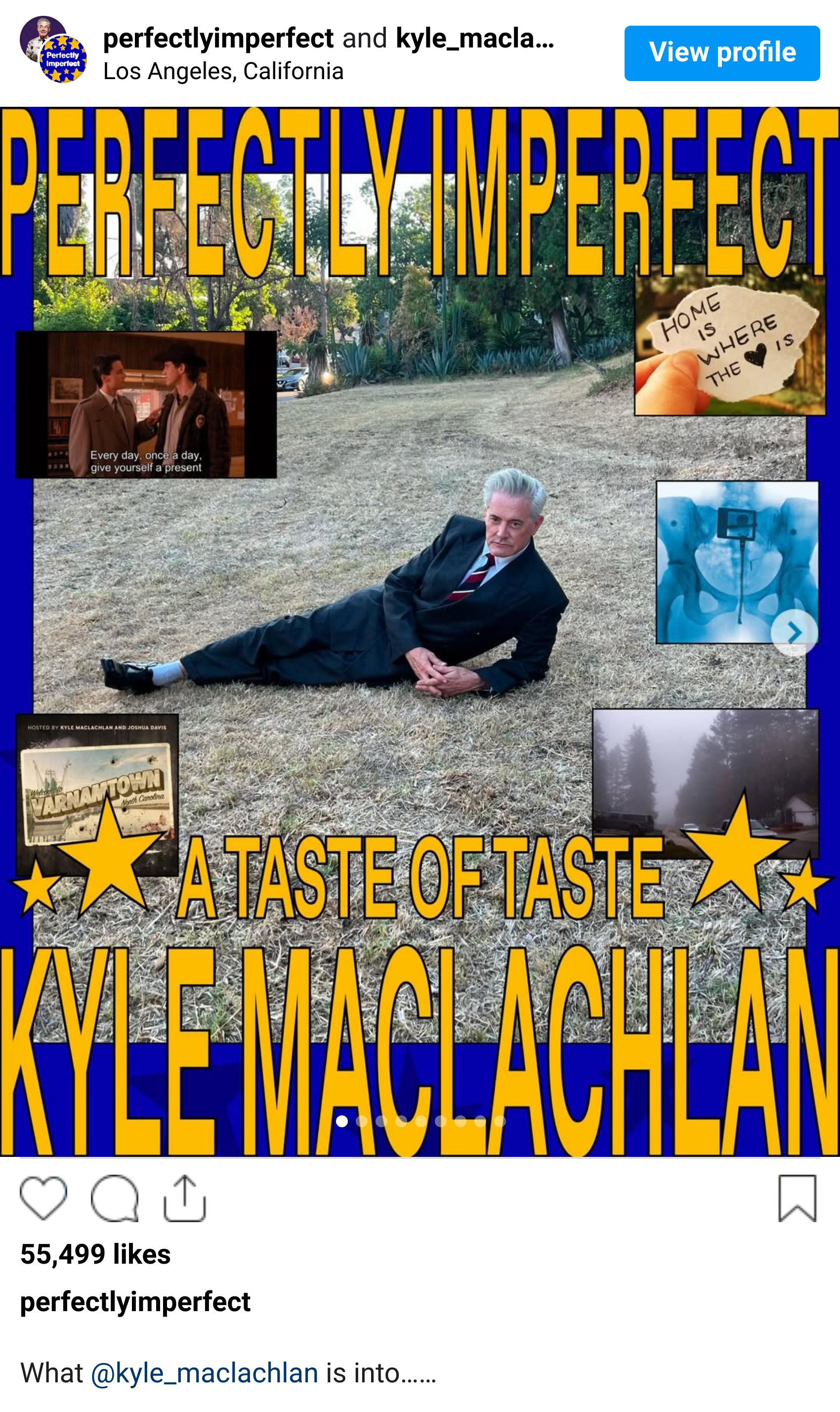
Part of the app’s genesis was that readers so wanted to be featured, they’d started making bootleg graphics and sharing them on Instagram. “A light bulb went off,” Tyler told us, “and I started to think about what this recommendation format could look like as a platform where people could share all the different aspects of their tastes.”
Why Perfectly Imperfect left Substack
In practice, Tyler’s severance package was seed funding for a new platform: PI.FYI. It’s a short step from the newsletter — a curated schedule of people sharing “a taste of their taste” — to the app, where anyone can share anything they’re into.
In the Times feature, Tyler described their app as “Letterboxd meets Myspace," which remains accurate. He told us he’d “always been frustrated” that people have to express and catalog their diverse tastes across dedicated apps — Letterbox, Goodreads, Belli. In his vision, PI.FYI would be a “home base for taste.”
When they left Substack, it was not for beehiiv, Ghost, or any other solution; their vision, now focused on the app, required a purpose-built tool. The primary issue behind their decision stemmed from friction in combining monetization on Substack with their nascent app; they needed a seamless way for users to pay for content and app features in a single transaction.
“I was interested in having more control of our community and being able to show content from our social app dynamically in the newsletter that you receive every day. Doing something like that with Substack was honestly impossible.”
In any case, Tyler and his co-founder, Alex, are both software engineers; they could build such a tool and never wanted to have to make the decision and do the work of leaving a platform again.
In the eight months following his layoff, Tyler turned his six-month severance package, savings, and newfound income from the newsletter into an ambitious business. They launched a closed beta in October 2023, barely three years after sending the first newsletter.
A few months later, in January 2024, Perfectly Imperfect received dedicated coverage in the Times for the second time— “Can Everyone Be a Tastemaker?”
Their app was out of beta.
In the few days following the Times profile in January 2024, itself occasioned by the app’s public launch, the app received around 20,000 new users.
They weren’t prepared. The site “was so slow,” and all their servers crashed.
In October 2024, they announced they were leaving Substack and launching a business all their own. Today, Tyler tells me, they have over 400,000 users, and the site adds 6 new recommendations per minute.
“Our platform ambition is to basically have a million Perfectly Imperfects functioning on the site, run by users, editors, and curators.
Since launch, they’ve added a few flagship features on top of recommendations. First, last summer came an event tool inspired by the Facebook events of Tyler’s youth — an unoptimized alternative to the slick new Partifuls and Lumas.
More recently, they launched Scenes, a community feature we might understand as PI’s subreddits. Soon they’ll launch the Editor user role — not moderators, they say, but curators, guardians of Scenes.
Perfect brand deals
While Tyler declined to share a current paid subscriber count, in an August 2024 interview, he reported around 2,000 paid subscribers as of that July. But the meat of PI’s revenue currently comes from brand deals — even as they’re picky about partners and only engage one most months.
Recent partners include Hinge, Arc'teryx, A24, and Patreon; they’re currently working on a project with Ace Hotels. In practice, these partnerships may include newsletter content, events, or videos. Tyler describes the partnerships as “letting them have access to our worlds and building something cool for them.”

The Hinge partnership is an excellent case study:
Hinge wanted to run a campaign addressing Gen Z loneliness
PI used their "Ask" feature to solicit stories from the community ("How did you get over an awkward situation?" or "What interest led to something new?")
They received hundreds of responses from their community
PI packaged those into "The Guide to Being Awkward, Together"
Hinge bought a billboard promoting the guide
PI had comedian Rachel Coster make a video based on the guide, featuring a slew of former PI guests
Finally, they threw a bowling tournament together, pairing strangers on teams
Months after the fact, back at the bowling alley, Tyler ran into two people wearing jerseys made for the event; the pair had met there and become friends. There’s no better proof of concept.
Brand partnerships, however, cannot continue to remain the bulk of Perfectly Imperfect’s revenue. The company — no longer just a newsletter — must unlock app subscription revenue and more to match its ambitions.
“As we scale, there'll be more ingredients of our revenue from subscriptions, creator economy, affiliate, advertising. But right now we're focused on brand partnerships because it's a bigger cash chunk, and we can do something really unique and bespoke that feels true to our world.”
Subscriptions, SaaS, and beyond
Of that 400,000-some total audience, still a fraction are paying users of the app. Tyler told us they’ve been growing rapidly over the last six months, including 55% month-over-month user growth. Their attention is turning to a revamped subscription product and conversion, both to paid and to the various features they’ve launched since the app first went live.
Besides editorial, profile customization remains the core appeal for paid users; Tyler says the team is currently focused on “making sure that when you go paid on Perfectly Imperfect, it's because you want your profile to look sick. You want it to be this amazing online presence, a corner of the internet that feels exactly like you.”
To support new features, they recently rewrote the app’s backend from the ground up.

The PI.FYI homepage on March 31, 2026.
The team includes four full-timers: Tyler, his co-founder Alex, another engineer, and one person handling media operations — scheduling, booking, outreach. In addition, they have part-time team members focused on graphics, brand partnerships, and product design.
They quietly raised a bit of capital last year to build a team and the app; Tyler says he’s preparing to raise more to fuel growth and build the app to realize his vision.
“In some ways, we're an investor's worst nightmare, where we're trying to build Tumblr that's also Vice — we're coming at it from a very different way foundationally, but we are trying to build businesses at those scales that live in the same ecosystem.”
The Vice side — which is to say, editorial — they’ve nailed. And they’re only continuing to develop here; they launched six new columns in February. The app may be an increasing priority, but the editorial remains crucial. Their first big-swing digital cover story is currently in the works.
There may be elements of SaaS revenue, Tyler tells us (giving users access to PI’s custom email infrastructure), as well as a creator economy element: people monetizing their own audiences on the platform — in this case, PI — might take a “very small cut.” Eventually, they’ll need to find a “version of advertising on PI that feels native and new and different.”
For now, they’re just focused on building a unique space on the internet where “everything you’re seeing is ultimately just human content.”
“No one's taste is algorithmic. We absorb life experience, and that shapes our taste. And that's what we're interested in scaling.”
The challenge is to scale subcultural appeal while keeping it natural. There is a long road yet to walk before they realize Tyler’s Warholian ambition for “everyone in the entire world to have a Perfectly Imperfect interview.” And they plan to walk this path rejecting all the norms of social platforms before them — no intrusive display ads, and thus no algorithms designed to keep users scrolling through ads.
Perhaps the truest sign of their success will be when, one bold day, a PI.FYI user, their ambitions outgrowing the limitations of the platform at last, slouches away to build their own.
Connect with Tyler on LinkedIn.
Follow Perfectly Imperfect on Instagram.
Check out PI.FYI.
